
SFO vs MFO in Singapore: Which Structure to Choose
Compare service scope, licensing, cost, control and tax considerations when selecting a family-office arrangement.
An SFO serves one family; an MFO serves several. The decision depends on investment needs, governance, staffing and cost. An SFO may qualify for a licensing exemption, while third-party fund management generally requires a licence or an applicable institutional exemption. Either model can support a family’s use of a VCC, but the VCC must appoint its own eligible manager. Tax relief is a separate application.
What is the main difference between an SFO and an MFO?
An SFO is a private, in-house operation for one family. Because it only manages related-party money it relies on the SFO class licensing exemption and needs no CMS licence. An MFO is a commercial firm serving multiple families for fees; that is third-party fund management, so it must be licensed. The SFO buys control and privacy at full cost; the MFO buys ready capability at shared cost.
SFO vs MFO — side by side
| Factor | Single Family Office (SFO) | Multi-Family Office (MFO) |
|---|---|---|
| Families served | One | Several |
| Whose money | The family's own | Third-party clients |
| Licence | Usually exempt (SFO class exemption, notified to MAS) | CMS licence (A/I LFMC) |
| Control | Full — family sets everything | Shared — firm sets the platform |
| Privacy | Highest | Lower (shared infrastructure) |
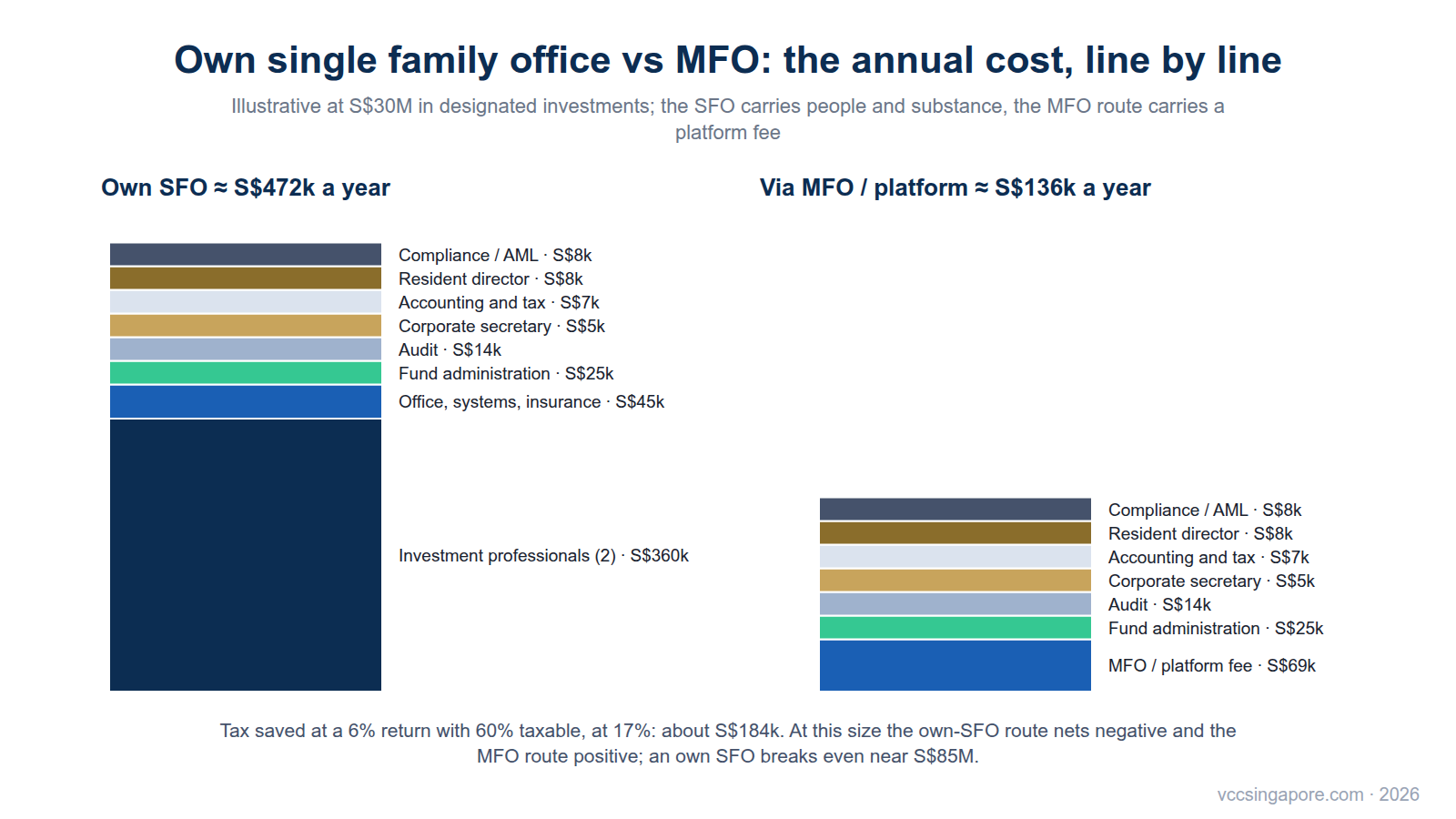
| Cost to the family | Full run-rate S$300k–1.5M/yr | Fees only; cost spread across families |
| Tax incentive | Own 13O/13U fund | Per-family ring-fenced sub-fund can carry one |
| Customisation | Tailored | Menu-based, configurable |
| Sensible AUM | ~S$20–50M+ investable | Any size that meets the MFO's minimum |
When should I choose a single family office?
Choose an SFO when you want full control, privacy and tailored strategy and you have enough AUM to absorb the fixed cost — generally at least S$20–50 million of investable assets so the S$300k–1.5M annual run-rate is a small fraction of returns. An SFO also makes sense when the family wants a durable, controlled succession vehicle and is willing to staff the investment professionals the tax incentive requires.
When to consider a multi-family office
An MFO provides access to an existing investment team and operating platform. It may suit a family that does not require a dedicated office or prefers to outsource management. Compare its mandate, fees and decision-making arrangements with those of an external asset manager and a dedicated SFO.
Can I switch from an MFO to an SFO later?
Yes. The common trajectory is MFO/EAM first, dedicated SFO once AUM crosses the threshold where the fixed cost is worthwhile — frequently migrating the assets into a VCC the family controls and applying for the family's own 13O or 13U award at that point.
Discuss the appropriate family-office model
Outline the family’s investment mandate, service requirements and timeline. Request a specialist introduction to compare dedicated and shared-service arrangements.
Get matched →Frequently asked questions
What is the main difference between an SFO and an MFO?
An SFO manages one family's own money and can usually operate licence-free under the SFO class exemption, notified to MAS; an MFO manages several families' money for a fee, which is licensable, so it must hold a CMS licence. SFO trades cost for control; MFO trades control for shared cost.
When should I choose a single family office over a multi-family office?
When you want full control, privacy and tailored strategy and have enough AUM — usually S$20–50M+ investable — to absorb the S$300,000 to S$1.5 million annual run-rate. Below that, an MFO usually delivers more per dollar.
Can I switch from an MFO to a single family office later?
Yes. Many families start with an MFO or external asset manager and spin up a dedicated SFO once AUM justifies the fixed cost, often migrating assets into a VCC they control.
VCC Singapore is an independent informational resource and is not a regulator, law firm or tax adviser. Licensing and tax requirements are set by MAS and IRAS and change periodically — confirm the current position before acting. This page is general information, not legal, tax or financial advice.