
Establishing a fund in Singapore
Choose the vehicle, management and offering arrangements; then coordinate registration, providers and the first close.
A fund launch begins with its investment mandate and intended investors. The legal vehicle, management authority, offering route and tax position follow from those requirements. A VCC is one fund vehicle; it is not a fund management licence.
Fund formation and operating responsibilities
The sponsor defines the proposed mandate and commercial terms. The manager accepts responsibility for the activities within its mandate. The board governs the VCC, while administrators and other providers perform their agreed functions. Establish those responsibilities before signing a launch timetable.
For the legal architecture, see VCC structure. For the filing sequence, documents and fees, use setting up a VCC.
Step 1 — Choose your fund vehicle
| Vehicle | Decision to assess |
|---|---|
| VCC | Standalone or umbrella, variable capital and separate sub-fund accounting. Appoint a permissible fund manager. |
| Singapore company | No VCC sub-fund framework. Assess capital/distribution rules and the proposed investment business. |
| Limited partnership | Assess partner roles, liability, governance, investor requirements and any applicable tax scheme. |
| Unit trust | Assess trust documentation, trustee responsibilities and the relevant offering rules. |
The VCC can support open-ended or closed-ended strategies. Choose investor dealing terms that match asset liquidity. Compare VCC, unit trust and limited partnership before selecting a vehicle.
Step 2 — Select the management arrangement
A VCC must appoint an eligible permissible fund manager. The sponsor may establish a licensed management company or appoint an existing manager. Agree investment discretion, execution, oversight, reporting and exit terms; a licence is not borrowed or rented.
For a venture strategy, the VCFM regime is a licensing regime with specific conditions, not a general registration shortcut. For a non-VCC vehicle, assess the actual regulated activities and exemptions. An exempt SFO can manage qualifying family arrangements but its general exemption does not make it a permissible VCC manager.
Step 3 — Incorporate the vehicle with ACRA
Use the registration process for the chosen vehicle. For a VCC, ACRA permits constitution subscribers with Singpass to file directly; foreigners without Singpass must engage a corporate service provider. Prepare the manager’s declaration, constitution, officer/subscriber particulars and registered office.
The detailed VCC filing checklist follows ACRA’s current guide. A new VCC name and incorporation cost S$8,015 before any sub-fund registration or professional fees.
Step 4 — Appoint the service providers
Agree a written operating scope rather than a list of firm names.
| Function | Questions for the launch brief |
|---|---|
| Management and board | Who approves investments, conflicts, delegations and exceptions? |
| Fund administration | Who maintains books/registers, calculates NAV, reconciles assets and reports to investors? |
| Custody and banking | How are assets held and cash movements authorised under the applicable rules? |
| Audit and secretary | Who prepares the audit records, annual filings, registers and statutory calendar? |
| AML/CFT | Which eligible financial institution performs the measures, and how does the VCC oversee compliance? |
| Tax and reporting | Who assesses the scheme, prepares the application and monitors continuing conditions? |
Compare administration scope and the public provider directory. The administrator, manager and auditor are distinct roles even where services share one group.
Step 5 — Assess the available tax incentives
Tax treatment is a separate assessment of the vehicle, manager, investments, income and award conditions. A VCC may be considered for 13O or 13U; 13OA is the Singapore limited-partnership scheme, and 13D addresses qualifying offshore funds. These are not interchangeable vehicle labels.
Commercial non-SFO and SFO conditions differ. The manager’s licensing status alone does not settle the track. The two-track guide explains entry versus annual tests and award dates. Use MAS Circular 05/2026 and the actual award rather than a generic “tax-free fund” assumption.
How long does the whole thing take?
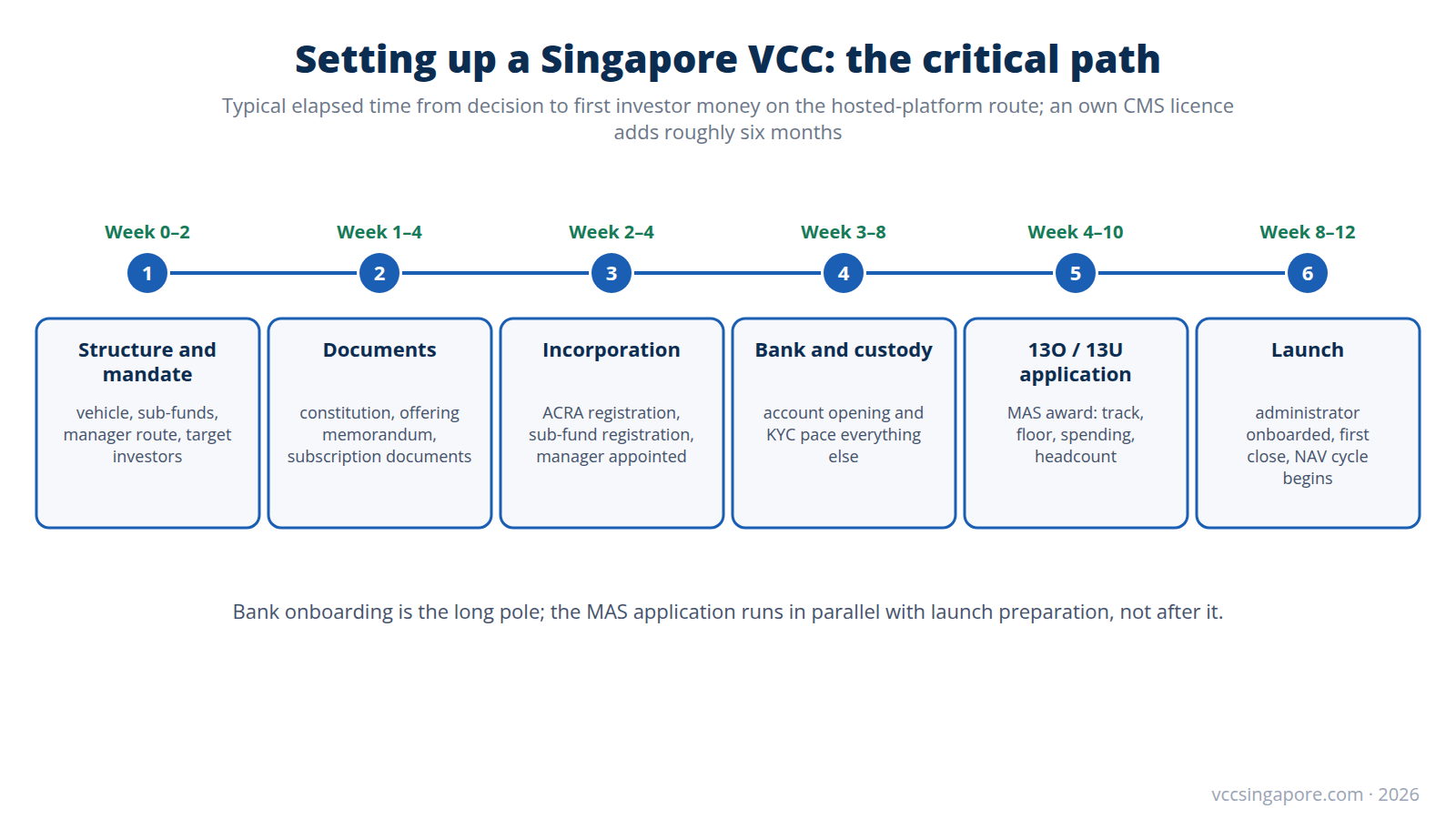
Registration is one workstream. ACRA lists 14–60 days for VCC approval. Manager acceptance, documentation, accounts, provider systems, investor checks and any tax award each have their own dependencies. Ask who owns each unresolved item and whether it prevents the first close.
The end-to-end checklist
| Before first close | Evidence to agree |
|---|---|
| Mandate and investors | Asset types, strategy, investor categories/jurisdictions and dealing frequency. |
| Vehicle and offer | Selected structure, constitutional/offer documents and applicable offering conditions. |
| Management | Accepted mandate, documented authority and activity/licensing assessment. |
| Operations | Accounts, books, register, NAV policy, reconciliation and exception escalation. |
| Investor onboarding | Completed checks, subscription acceptance and cash/asset settlement controls. |
| Budget and timetable | Comparable provider scope, recurring/exception fees, dependencies and accountable owners. |
For an initial introduction, a short summary is enough: strategy, asset types, investor profile, new or existing structure, anticipated size, timing and the services required. Send that brief through Contact us; do not attach investor or account records to a general enquiry.
Discuss your fund launch
Describe the strategy, investor types, proposed structure and support required. Request an introduction for licensed fund management or fund administration.
Contact us →Related formation guidance
Use the dedicated private-equity launch guide, venture-capital guide or hedge-fund guide for strategy-specific operating decisions. Families should compare the consolidated family routes; an EAM should first decide whether pooled fund terms suit its clients.
Frequently asked questions
What are the steps to start a fund in Singapore?
Choose the vehicle and offering route, settle the management arrangement, prepare the documents, register the vehicle, appoint providers and complete accounts, investor onboarding and launch controls. Assess tax eligibility separately.
Do I need a fund management licence to start a fund in Singapore?
For a VCC, an eligible permissible fund manager must be appointed. The sponsor may appoint an existing manager instead of seeking its own licence. For other structures, assess the actual activities, licensing requirements and applicable exemptions; there is no universal exemption for a sponsor.
How long does it take to start a fund in Singapore?
There is no single launch timetable. ACRA states 14–60 days for VCC registration approval, while manager acceptance, account opening, documentation, investor checks and tax approvals have separate dependencies.
How much does it cost to start a fund in Singapore?
For a new VCC, ACRA charges S$15 for the name, S$8,000 for incorporation and S$400 per sub-fund. Management, legal work, administration, audit, banking, custody and tax work are separately quoted. Regulatory capital for an own-manager licence is not the VCC incorporation fee.