
VCC sub-fund platforms for external asset managers
Compare individual custody mandates with an umbrella VCC, including administration, sub-fund segregation, manager appointments and potential 13O/13U eligibility.
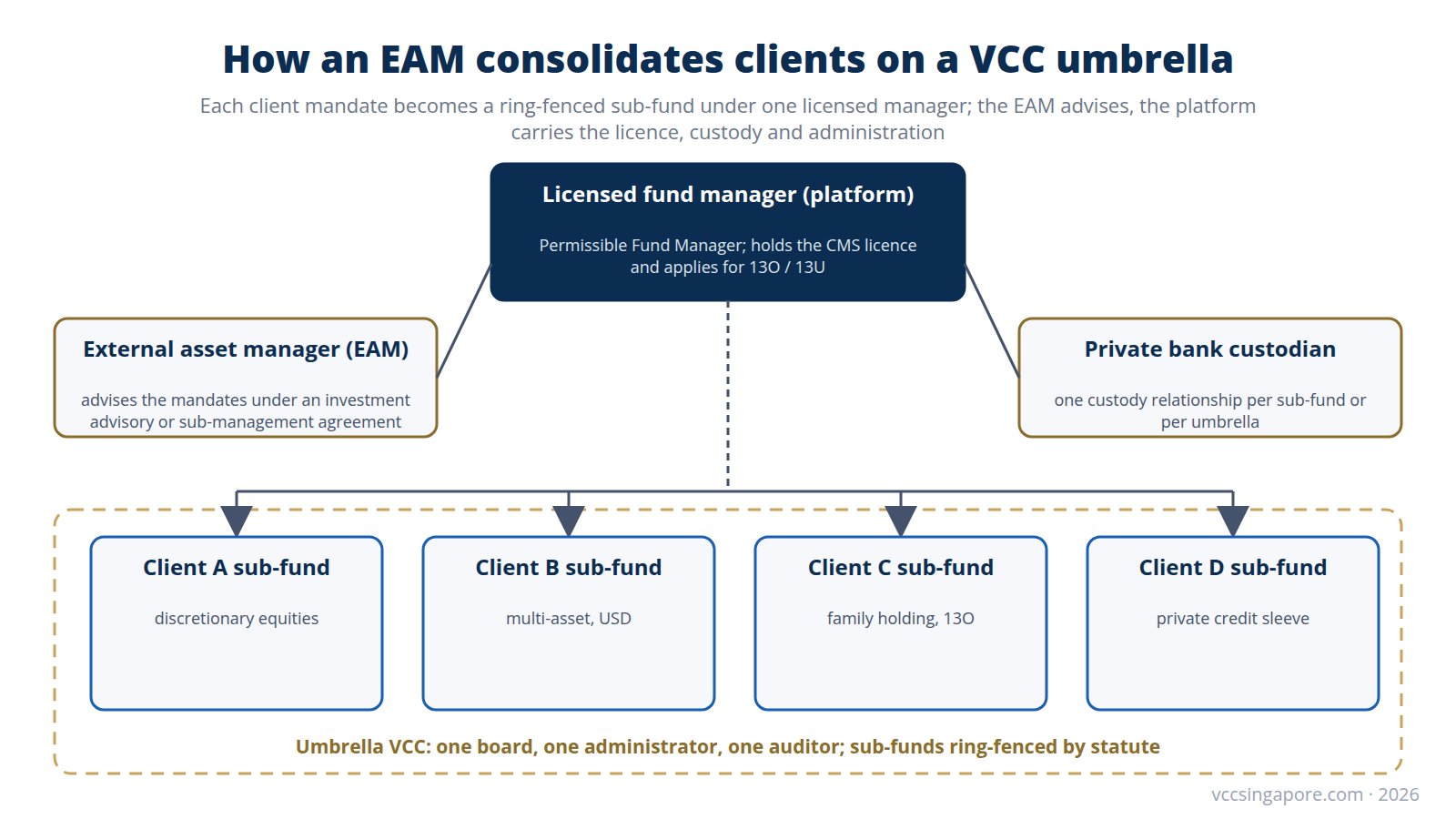
An external asset manager (EAM) considering pooled investment mandates should compare a VCC sub-fund platform with separate custody accounts managed under limited powers of attorney. A Variable Capital Company (VCC) can hold multiple sub-funds within one legal entity. Each sub-fund may serve a client mandate or investment strategy; segregation operates between sub-funds, not automatically between investors in the same sub-fund. Shared administration can reduce duplicated work. Assess 13O/13U fund tax incentives separately, including the fund’s eligibility, operating costs and investor tax positions.
The decision depends on the client mandates, investment strategies and operating costs. The sections below compare the two models, explain sub-fund segregation and consider the role of an appointed fund manager.
When does an EAM outgrow the LPOA model?
Individual custody mandates can suit a small number of bespoke relationships. As the client base grows, assess the following operational demands:
- Every new client means another custody account to open, another set of statements to reconcile, another mandate to administer.
- There is no pooled vehicle, so clients cannot share a single strategy cleanly, and you cannot run a track record at fund level.
- Individual accounts get no fund-level tax treatment — the 13O/13U incentives require a qualifying fund, not a custody account.
- Onboarding new investors, charging performance fees, and reporting all scale poorly.
These pressures warrant a comparison of operating models. Assess whether a VCC would suit the client mandates and whether the shared administration benefits justify its establishment and continuing costs.
LPOA accounts vs a VCC sub-fund platform — compared
The table compares administration, segregation and management arrangements under the two models.
| Dimension | Individual LPOA accounts | VCC sub-fund platform |
|---|---|---|
| Structure | One custody account per client | One VCC umbrella, a ring-fenced sub-fund per client / strategy |
| Asset segregation | By separate bank accounts | Statutory, under Section 29 of the VCC Act |
| Administration | Replicated per account | Shared across sub-funds — economies of scale |
| Audit & reporting | Per account | One fund administrator / auditor for the umbrella |
| Tax treatment | None at fund level | Can apply for 13O / 13U exemption on qualifying income |
| Pooling clients into one strategy | Hard — each account traded separately | Natural — sub-fund or shared sub-fund |
| Performance fees / track record | Account-level, fragmented | Fund-level NAV and track record |
| Manager licence | EAM's own CMS licence (or permissible manager) | Must appoint a Permissible Fund Manager (can be a third party) |
| Best when | A few individually managed relationships | Multiple mandates with a case for shared fund administration |
How does the VCC ring-fence each client?
The assets and liabilities of sub-funds are segregated under the VCC Act. Assets attributed to one sub-fund cannot be used to discharge another sub-fund’s liabilities. This separation does not eliminate investment losses, and investors in the same sub-fund share that sub-fund’s exposures. See the VCC structure guide for umbrella and standalone arrangements.
Can you launch without your own fund-management licence?
A VCC can appoint an existing permissible fund manager. That manager must perform its management responsibilities; its licence does not extend to a separate EAM. Define the EAM’s proposed activities and assess any advisory or discretionary role before launch. Compare the transition in from EAM to licensed fund manager + VCC and the requirements for setting up an EAM in Singapore.
What tax treatment does pooling onto a VCC give access to?
A VCC can apply for Singapore's 13O (onshore) or 13U (enhanced-tier) fund tax incentives, under which qualifying fund income is exempt from Singapore tax. Pooling clients onto one platform can make the AUM, investment-professional and local-business-spending thresholds easier to meet than each client structuring alone. The current numbers — and which scheme fits — are on our 13O/13U tax incentives hub, and EAMs specifically should read do EAMs need a 13O/13U structure for clients?.
What does it cost to set up and run?
A VCC platform carries incorporation, fund-administration, audit, and ongoing compliance costs — offset against the per-account costs you remove and the tax you may save. The economics tip in the VCC's favour as the number of clients and total AUM rise. Model your own numbers with the VCC cost calculator before committing, and read the broader case for family office structures if some of your clients are family-office-scale.
Assess a VCC platform for your client mandates
Describe your client mandates, investment strategies and administration requirements to request an introduction to a licensed fund manager.
Get matched to a specialist →Frequently asked questions
Why would an EAM move clients into a VCC?
A VCC may combine mandates or strategies within an umbrella and share administration and audit arrangements. Whether this improves on separate custody accounts depends on costs, investment terms and client needs. Segregation applies between sub-funds; investors within a sub-fund share its exposures. Tax-incentive eligibility must be assessed separately.
Can an EAM run a VCC without its own fund-management licence?
A VCC can appoint an existing permissible fund manager, but this does not extend the manager’s licence to the EAM. The EAM’s own activities and any advisory or discretionary role require a separate assessment. A later application for its own CMS licence is a distinct process.
How does a VCC sub-fund ring-fence each client?
Sub-fund assets and liabilities are segregated under the VCC Act. One sub-fund’s assets cannot meet another sub-fund’s liabilities. This does not remove investment risk or separate investors who hold shares in the same sub-fund.
Does moving to a VCC give EAM clients tax benefits?
A VCC can apply for Singapore's 13O or 13U fund tax incentives, under which qualifying fund income is exempt from Singapore tax. Pooling clients onto one VCC platform can make meeting the AUM, investment-professional and local-spending thresholds more achievable than each client structuring alone. Eligibility must be confirmed with MAS.
VCC Singapore is an independent informational resource and is not a regulator, law firm or tax adviser. VCC, licensing and tax rules are set by MAS, ACRA and IRAS and change periodically — confirm current requirements before acting. This page is general information, not legal, tax or financial advice.