
Umbrella VCC, Sub-Funds & Ring-Fencing: How Section 29 Segregates Liability
The relationship between an umbrella VCC and its sub-funds, statutory asset and liability segregation, and the choice between umbrella and standalone structures.
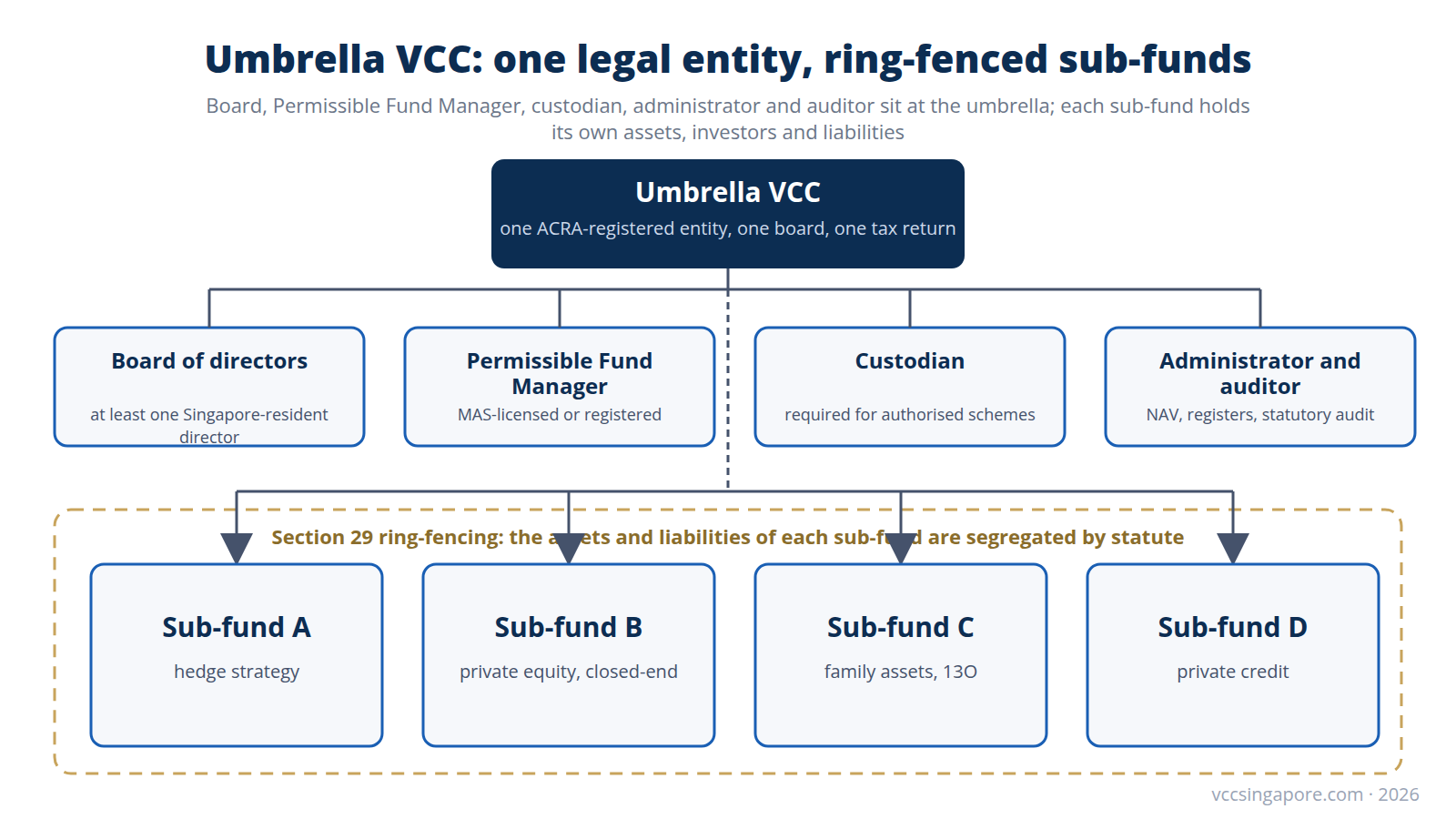
An umbrella VCC is a single Variable Capital Company that holds multiple sub-funds, each with its own strategy, investors, assets and net asset value. The defining feature is ring-fencing: under Section 29 of the Variable Capital Companies Act 2018, the assets and liabilities of each sub-fund are legally segregated, so the assets of one sub-fund cannot be used to meet the liabilities of another. This lets a manager run several distinct funds under one entity — one incorporation, one board, one fund manager — without the strategies bleeding risk into one another. It is the Singapore onshore answer to the Cayman segregated portfolio company.
This guide sits under the VCC structure hub. If you are still deciding between a fund vehicle and an ordinary company, see VCC vs Private Limited Company; if you are comparing onshore against offshore segregation, see VCC vs Cayman SPC.
What is a VCC sub-fund?
A sub-fund is a ring-fenced compartment within an umbrella VCC. It has its own portfolio, its own shareholders, its own subscription and redemption terms and its own NAV — it operates, for investors, exactly like a standalone fund. What it is not is a separate legal person: the umbrella VCC is the single legal entity that contracts, holds assets and faces the regulator. Each sub-fund is registered with ACRA and carries its own unique identifier, and its accounts are kept separately. This separation is what allows one umbrella to carry, say, a long/short equity sub-fund, a private credit sub-fund and a real-estate sub-fund side by side.
The protection provided by Section 29
Section 29 does three things. First, the assets of a sub-fund must be used only to discharge the liabilities of that sub-fund — they cannot be applied to another sub-fund or to the umbrella's general liabilities. Second, any liability of a sub-fund must be discharged solely out of that sub-fund's assets. Third, if a sub-fund's assets are exhausted, its creditors generally cannot reach the assets of other sub-funds. In practice this means a blow-up in one strategy is contained: investors and creditors of Sub-Fund A look only to Sub-Fund A. The Act also allows a single sub-fund to be wound up without dragging down the rest of the umbrella.
One board · one Permissible Fund Manager · one auditor · registered with ACRA
| Question | Umbrella VCC | Standalone VCC |
|---|---|---|
| Number of strategies | Many (one per sub-fund) | One |
| Legal entities | One umbrella entity | One entity |
| Liability between pools | Segregated under Section 29 | Not applicable (single pool) |
| Cost to add a strategy | Add a sub-fund — cheaper, faster | Incorporate another VCC |
| Shared overhead | One board, secretary, auditor, manager | Dedicated to that fund |
| Best for | Multi-strategy managers, platforms, EAMs | Single-strategy or single-mandate funds |
When should I choose an umbrella over a standalone VCC?
Choose the umbrella if you expect more than one strategy, multiple investor pools, or different share classes that you want walled off from each other — and especially if you want to add funds cheaply over time. An external asset manager consolidating client mandates onto a VCC platform almost always wants the umbrella, because each client or strategy becomes a sub-fund without a fresh incorporation. Choose a standalone VCC if you genuinely only ever expect one strategy and value the simplest possible structure. You can also start standalone and convert your thinking later, but planning the umbrella up front is usually cheaper than retrofitting.
How are sub-funds set up and administered?
Each sub-fund is registered with ACRA under the umbrella and must be kept administratively distinct: separate books and records, separate bank and custody accounts, and clear allocation of shared costs. The umbrella's single board, company secretary, auditor and fund manager service all sub-funds, but the fund administrator strikes a separate NAV for each. Because the umbrella has no audit exemption, every sub-fund's financials feed the umbrella audit. Getting this operational separation right is what keeps the Section 29 ring-fence credible — sloppy commingling of cash or records is the classic way to undermine it. See setting up a VCC for the full operational checklist.
Does ring-fencing hold up across borders?
Within Singapore, Section 29 is a clear statutory protection. The harder question is whether a foreign court will respect the ring-fence if a sub-fund's counterparty sues offshore. This is the same recognition question that applies to Cayman segregated portfolio companies, and it is one reason substance and careful contracting matter. For managers weighing the onshore VCC ring-fence against offshore alternatives — and the treaty access that comes with Singapore domicile — see VCC vs Cayman SPC.
Discuss a multi-strategy VCC
Outline the proposed strategies and investor pools. We can introduce a licensed fund manager to assess the umbrella structure and the responsibilities for each sub-fund.
Discuss your requirements →How do tax incentives apply to an umbrella and its sub-funds?
A fund tax incentive can be applied for at the umbrella level and treated as covering its sub-funds, which is administratively efficient — but the AUM and economic-substance conditions still have to be met. How those conditions are tested for an umbrella matters for planning, so read the tax pillar alongside this page: Singapore fund tax incentives and 13O vs 13U. Family offices frequently use the umbrella to separate asset classes within one wrapper — see the VCC as a family office vehicle.
Frequently asked questions
What is a VCC sub-fund?
A sub-fund is a separate, ring-fenced pool of assets and liabilities within an umbrella VCC. Each sub-fund has its own strategy, investors and net asset value, but the umbrella is the single legal entity. Sub-funds are not separate legal persons, yet their assets and liabilities are legally segregated under Section 29 of the VCC Act.
What does ring-fencing mean in a VCC?
Ring-fencing means the assets of one sub-fund cannot be used to satisfy the liabilities of another sub-fund or of the umbrella. Under Section 29 of the Variable Capital Companies Act, the assets and liabilities of each sub-fund are segregated, so creditors of one sub-fund have no claim on another's assets.
Should I choose an umbrella or a standalone VCC?
Choose an umbrella if you plan multiple strategies, share classes or investor pools and want to add sub-funds cheaply over time. Choose a standalone VCC if you only ever expect one strategy and prefer the simplest possible structure. Most managers planning to grow choose the umbrella.
VCC Singapore is an independent informational resource and is not a regulator, law firm or tax adviser. The VCC framework is governed by ACRA and MAS and changes periodically — confirm current rules before acting. This page is general information, not legal, tax or financial advice.