
Looking for the industry-wide picture rather than the EAM model? Start with asset management in Singapore: how the S$6.7 trillion industry works.
External asset managers provide wealth management services separately from a custodian bank. Clients may appoint an EAM to coordinate investment mandates and reporting across banking relationships. This guide considers the services available, the division of responsibilities and the factors to assess before making an appointment.
What Are External Asset Managers (EAMs)?
External Asset Managers (EAMs), also known as Independent Asset Managers (IAMs), are non-bank entities offering customized wealth management services. Unlike private banks, EAMs operate independently but collaborate with financial institutions to access a wide array of investment opportunities and banking solutions.
Core Principles
- Independence: assess the EAM’s ownership, product relationships, remuneration and conflict-of-interest disclosures. Independence from a bank does not by itself establish that advice is free of conflicts.
- Long-term planning: agree the investment objectives, risk limits, liquidity needs and time horizon before selecting a strategy.
Why Singapore?
- Robust Regulatory Framework: Governed by the Monetary Authority of Singapore (MAS), EAMs benefit from a stable and secure financial environment that prioritizes investor protection.
- Tax Efficiency: Beneficial tax structures, including Double Taxation Avoidance Agreements (DTAs), allow clients to minimize liabilities and enhance returns.
- Strategic Location: As a global financial hub, Singapore offers access to both Asian and international markets, attracting investors from around the world.
Why Choose an External Asset Manager (EAM)?
- Advice and incentives: review how the EAM is paid, including product-related remuneration, and how potential conflicts are disclosed and managed.
- Service model: confirm the proposed team, its client workload and the scope of investment advice, reporting and coordination.
- Multi-Bank Access:
- Diversify custodial risks by holding assets across multiple banks.
- Compare the investment products and services available through each banking relationship, including eligibility and cost.
- Cost Transparency:
- Fees: review management and performance fees alongside custody, transaction and product charges. A flat or performance-based fee does not necessarily capture the full cost.
- Regional and Global Expertise: EAMs use their local and international networks to operate effectively in complex markets.
- Comprehensive Solutions:
- Address a wide range of client needs, from tax optimization to philanthropy advisory, ensuring a holistic approach to wealth management.
Services Offered by EAMs
Investment Management
An investment mandate should reflect the client’s objectives, risk tolerance, liquidity requirements and time horizon. Agree the EAM’s authority and the process for reviewing portfolio allocations before investing.
Investment options include:
- Equities: Opportunities in domestic and international stock markets, focusing on blue-chip stocks, growth stocks, and dividend-yielding companies.
- Fixed Income: Bonds, treasury securities, and other fixed-income instruments to provide stability and consistent returns.
- Real Estate: Direct investments in high-value properties or through real estate investment trusts (REITs), offering diversification and long-term growth.
- Alternative Investments:
- Private Equity: Investments in private companies for potentially higher returns over the long term.
- Hedge Funds: Active strategies aimed at absolute returns, irrespective of market conditions.
- Venture Capital: High-risk, high-reward opportunities in innovative startups and early-stage companies.
Portfolio analysis, periodic rebalancing and diversification support the investment process. Reporting should explain performance, risk exposures and any departure from the agreed mandate.
Wealth Planning
Wealth planning addresses ownership, succession and the responsibilities of family members and advisers. Depending on the engagement, an EAM may coordinate the following work with legal and tax specialists:
- Trust and Will Structuring: Establishing legally sound frameworks that outline the distribution of assets while minimizing potential conflicts and tax liabilities.
- Family Governance:
- Setting up formal governance structures, including family charters, to clarify roles and responsibilities within the family.
- Facilitating succession planning to prepare the next generation for wealth stewardship.
- Asset Protection: Implementing strategies to shield wealth from potential legal or financial risks.
- Philanthropy Integration: Incorporating charitable initiatives into wealth transfer strategies to align with family values and social impact goals.
Tax Optimization
Tax planning requires consideration of the client’s residence, asset locations and applicable rules. Clarify which work the EAM undertakes and which requires a qualified tax adviser.
Key tax strategies include:
- Double Taxation Avoidance Agreements (DTAs): Structuring investments to benefit from Singapore’s extensive network of DTAs, reducing withholding taxes on cross-border income.
- Efficient Asset Structuring: Organizing assets across jurisdictions to optimize estate taxes, capital gains taxes, and income taxes.
- Business Tax Planning: For clients with entrepreneurial interests, EAMs ensure tax-efficient operations and investments within their business structures.
- Relocation Advisory: Assisting clients in establishing tax residency in Singapore to benefit from its territorial tax system.
Philanthropy Advisory
Philanthropy advice connects the family’s charitable objectives with its funding and governance arrangements. Services may include:
- Establishing Charitable Structures: Setting up donor-advised funds, foundations, or endowments to facilitate efficient charitable giving.
- ESG integration: assess investments against the client’s environmental, social and governance preferences, alongside financial objectives and risks.
- Legacy Projects: Helping families design philanthropic projects that reflect their values and create a lasting legacy.
Risk Management
Risk management identifies portfolio exposures and the limits agreed in the mandate. Relevant tools may include:
- Diversification: Allocating assets across geographies, industries, and asset classes to mitigate concentration risks.
- Hedging Strategies: Using financial instruments like options, futures, and currency hedges to protect portfolios against adverse price movements.
- Stress Testing: Analyzing how portfolios perform under various economic scenarios to ensure resilience.
- Insurance Solutions: Recommending high-net-worth insurance products for wealth preservation and estate planning.
Investment access
Depending on its relationships and the client’s eligibility, an EAM may provide access to the following investments. Compare access, terms and risks with other available channels:
- Initial Public Offerings (IPOs): Early access to high-growth companies entering public markets.
- Private Placements: Customized investment deals tailored to sophisticated investors.
- Structured Products: Tailored financial instruments designed to meet specific objectives, such as capital protection or enhanced income.
- Tailored Funds: Private funds tailored to a client’s preferences, such as thematic investing (e.g., technology, healthcare, or sustainability).
Family Office Services
Family office support may extend beyond portfolio management. Confirm which of the following services are provided directly and which are coordinated with specialists:
- Operational Management: Handling day-to-day administrative tasks, from payroll to vendor coordination.
- Compliance Support: Ensuring adherence to regulatory requirements across jurisdictions.
- Investment Oversight: Crafting and executing long-term investment strategies that align with the family’s goals.
- Succession Planning: Preparing future generations to take on leadership roles within the family office or business.
- Educational Workshops: Empowering family members with the knowledge and tools to make informed financial decisions.
These services should form a defined operating arrangement, with clear responsibilities for investment management, administration, succession and family reporting.
How EAMs Collaborate with Private Banks
- Multi-Bank Partnerships:
- Collaborations with institutions like DBS Private Bank, UBS, and Julius Baer provide clients with diverse financial solutions.
- Negotiated Benefits:
- Compare the fees, product terms and service arrangements available through each custodian bank. Preferential terms should be confirmed in the proposal rather than assumed.
- Streamlined Client Representation:
- EAMs manage relationships with multiple banks, reducing administrative burdens and simplifying interactions.
Comparing EAM and private-bank arrangements
- Tailored, Client-Centric Approach:
- Review the adviser’s product range, remuneration and conflicts under each arrangement.
- Broader Financial Access:
- Multi-bank relationships can broaden product access and spread custody exposure, while adding coordination and reporting requirements.
- Transparent Fee Structures:
- Compare the effect of flat and performance-linked fees on the total cost and the manager’s incentives.
- Privacy and Discretion:
- Document how account information is shared between the EAM, custodian banks and other advisers.
Setting Up an External Asset Manager in Singapore
Licensing Requirements
- Regulated by the Monetary Authority of Singapore (MAS).
- Licenses include:
- Capital Markets Services (CMS) License: Required for fund management activities.
Compliance Obligations
- Adherence to Anti-Money Laundering and Countering the Financing of Terrorism (AML/CFT) regulations.
- Regular reporting on Assets Under Management (AUM) and client demographics.
Operational Setup
- Build multi-bank partnerships to provide clients with diverse custodial options.
- Recruit experienced portfolio advisors to manage client relationships effectively.
- Creating a platform for real-time reporting, portfolio tracking, and analytics.
Developments to assess when choosing an EAM
- Advice and remuneration: assess how the provider demonstrates independence and manages conflicts.
- ESG preferences: confirm how sustainability criteria enter portfolio selection and reporting.
- Digital Transformation:
- Technology: ask how analytics and automated tools are used, controlled and reviewed in the investment process.
- Digital tools enhance client engagement through real-time portfolio tracking and reporting.
- Cross-border service: assess the firm’s ability to serve the client’s jurisdictions and its arrangements with overseas providers.
- Collaboration with Family Offices:
- EAMs streamline wealth management, legacy planning, and philanthropic services by integrating with family offices.
Selecting an EAM
Compare prospective EAMs on the proposed mandate, team, custody arrangements, reporting and total fees. The appropriate service model depends on the client’s assets, jurisdictions and the work retained by other advisers.
Ask for a written service scope and clarify how investment, banking, tax and legal responsibilities are divided. Consult the Monetary Authority of Singapore (MAS) website for regulatory information.
Connect with EAMs
External asset management and family office services
Set out your investment mandate and family office requirements to request an appropriate specialist introduction.
Discuss your requirements →Frequently Asked Questions (FAQs)
What is an External Asset Manager (EAM)?
An EAM is a non-bank firm providing investment management or advisory services, often alongside a separate custodian bank. Review its permitted activities, ownership, remuneration and conflicts before assessing the independence of its advice.
Why are EAMs popular in Singapore?
Singapore provides a base for EAMs working with custodian banks and professional advisers. Clients should assess each firm’s regulatory status, service scope and fees against their own requirements.
How do EAMs differ from private banks?
An EAM is separate from the custodian bank and may work across several banking relationships. Compare its mandate, product access, fees and conflicts with the proposed private-bank arrangement.
What licenses are required to set up an EAM in Singapore?
An EAM carrying on fund management generally requires a CMS licence unless an exemption applies. The accredited/institutional LFMC category serves accredited and institutional clients. The RFMC registration regime ended in 2024; an exemption should be assessed against the specific activities rather than treated as a general EAM status.
Can EAMs manage my family office?
Yes, many EAMs offer specialized family office services, including estate planning, philanthropy advisory, and operational management, tailored to meet complex family needs.
External asset managers in Singapore: key facts, with sources
The statements below are the ones most often asked about external asset managers, each with the primary source it rests on. Tax figures are for a fund under a licensed manager, the non-SFO track.
- What an EAM is
- An external asset manager, also called an independent asset manager, is a non-bank firm that manages a client’s portfolio while the assets stay in the client’s own account at a custodian bank. The client signs a limited power of attorney that lets the EAM trade the account but not withdraw from it. Source: Securities and Futures Act 2001, Second Schedule (fund management).
- The manager is licensed, never the fund
- Managing client portfolios is fund management, a regulated activity under the Securities and Futures Act 2001. A Singapore EAM holds a Capital Markets Services licence for fund management as a Licensed Fund Management Company unless a statutory exemption applies. The licence belongs to the manager, not to any fund or VCC. Source: Securities and Futures Act 2001, s 82 and Second Schedule; MAS Guidelines SFA 04-G05.
- Licence tiers and base capital
- An Accredited/Institutional LFMC may serve only accredited and institutional investors and needs S$250,000 base capital. A Retail LFMC needs S$500,000, or S$1 million if it manages a collective investment scheme offered to retail investors. Nearly every Singapore EAM holds the A/I licence. Source: Securities and Futures (Financial and Margin Requirements) Regulations; MAS Guidelines SFA 04-G05.
- The 120% financial-resources test
- An LFMC must keep financial resources of at least 120% of its total risk requirement at all times, on top of the base-capital floor. A shortfall is a notification event to MAS, not a year-end check. Source: Securities and Futures (Financial and Margin Requirements) Regulations.
- People
- MAS expects at least two directors with five or more years of relevant experience, one an executive director resident in Singapore; a resident chief executive with at least five years, ten for a Retail LFMC; and at least two full-time Singapore-resident professionals with five or more years each. Source: MAS Guidelines SFA 04-G05, admission criteria.
- The registered and exempt tiers are gone
- The Registered Fund Management Company regime, capped at S$250 million and 30 qualified investors, was repealed on 1 August 2024 and existing RFMCs became A/I LFMCs. The earlier Exempt Fund Manager status ended in 2012. Neither route is open to a new EAM. Source: MAS response to feedback on the repeal of the RFMC regime, 2024.
- Venture capital managers
- A manager confined to qualifying venture-capital funds may use the VCFM regime: a CMS licence granted on simplified criteria with no base-capital or risk-based-capital requirement and lighter conduct rules. A strategy that drifts beyond qualifying venture capital needs a full LFMC. Source: MAS VCFM regime, 2017; Guidelines SFA 04-G05.
- How to apply
- Applications go to MAS on Form 1 through its portal with a business plan, ownership chart, compliance arrangements and fit-and-proper details for shareholders, directors and representatives; the application fee is about S$1,000 per regulated activity. Budget four to six months from a complete submission to grant, less for a VCFM. Source: MAS, fund management licensing; Securities and Futures (Licensing and Conduct of Business) Regulations.
- Representatives, and how a client checks a firm
- Every individual who manages client money is an appointed representative notified to MAS, fit and proper and past MAS’s entry and examination requirements; the firm answers for them. Clients can check both the firm and the individual on MAS’s Financial Institutions Directory and Register of Representatives. Source: Securities and Futures Act 2001, Part 4 Division 3; MAS Notice SFA 04-N09.
- Custody
- An EAM never holds client assets. The firm is onboarded by each custodian bank, then each client opens an account in their own name and signs the bank’s limited power of attorney. Onboarding takes weeks to months; per-client minimums typically start around US$1 to 2 million. Source: Securities and Futures (Licensing and Conduct of Business) Regulations, customer-asset provisions; bank EAM-desk requirements.
- Ongoing obligations
- After licensing an LFMC keeps its base and risk-based capital, runs an anti-money-laundering programme under MAS Notice SFA04-N02, files audited accounts and periodic returns with MAS, holds professional indemnity insurance, and lodges changes to shareholders, directors and representatives. That fixed overhead, not the licence fee, is the real annual cost of independence. Source: Securities and Futures Act 2001; MAS Notice SFA04-N02.
- Who counts as an accredited investor
- An individual is accredited with net personal assets above S$2 million (primary-residence equity counted up to S$1 million), net financial assets above S$1 million, or income of at least S$300,000 in the preceding twelve months, and must opt in to be treated as one. Source: Securities and Futures Act 2001, s 4A; Securities and Futures (Classes of Investors) Regulations 2018.
- Pooling clients into a VCC
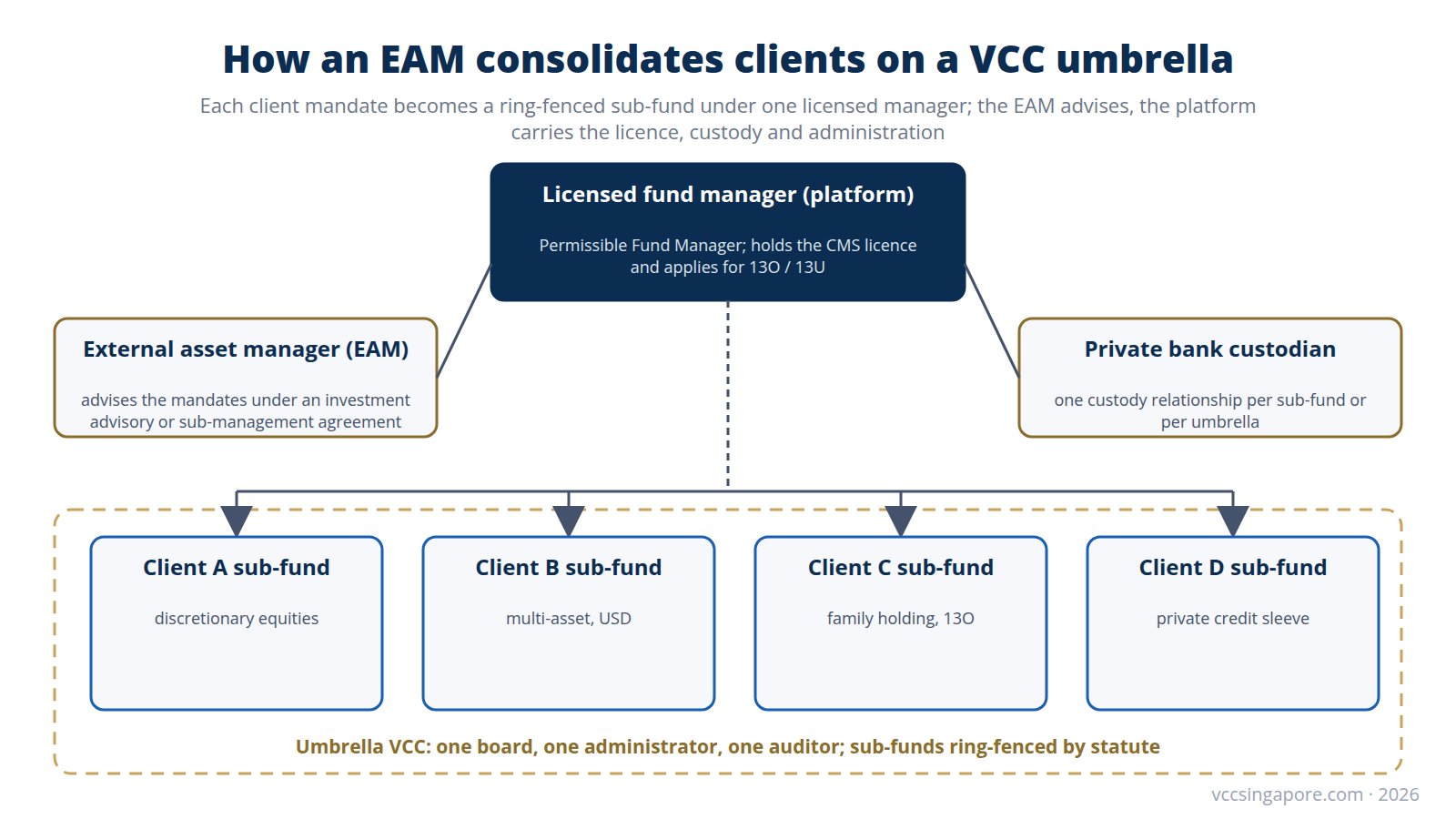
- An EAM that pools clients into a VCC must appoint a Permissible Fund Manager: an LFMC or VCFM, or an exempt financial institution such as a bank. That manager may be a third party, so an EAM can launch ring-fenced sub-funds under an existing licensed manager first and bring the licence in-house later. Source: Variable Capital Companies Act 2018; ACRA VCC FAQs.
- Tax on the pooled vehicle
- Accounts under a power of attorney get no fund-level exemption. A VCC under a licensed manager sits on the non-SFO track: 13O needs S$5 million in designated investments at application only, 13U S$50 million; two (13O) or three (13U) qualifying professionals at the manager; local spending of S$200,000, S$300,000 or S$500,000 by AUM band; no capital deployment requirement. Source: MAS FDD Cir 05/2026.
- The 30/50 test when pooling unrelated clients
- With fewer than ten investors, no Singapore-resident non-individual investor may hold more than 30% of a 13O fund, 50% with ten or more; the financial penalty falls on that investor, not the fund. 13U funds are outside the test. For an umbrella VCC the conditions are assessed at umbrella level. Source: Income Tax Act 1947, s 13O; Income Tax (Exemption of Income of Prescribed Persons) Regulations.
Frequently asked questions
What is an external asset manager (EAM)?
An EAM, also known as an independent asset manager (IAM), is a non-bank firm that provides customised wealth management advice. EAMs operate independently of any single bank but work with financial institutions to give clients access to a wide range of investment opportunities and banking solutions.
Where are client assets held when working with an EAM?
Client assets remain with custodian banks rather than with the EAM itself. Many EAMs maintain relationships with several banks, which lets clients diversify custodial risk across institutions and access products that no single bank offers.
How are EAMs regulated in Singapore?
EAMs are regulated by the Monetary Authority of Singapore (MAS). Fund management activities require a Capital Markets Services (CMS) licence, and firms must comply with anti-money laundering and countering the financing of terrorism (AML/CFT) requirements, including regular reporting on assets under management.
How does an EAM differ from a private bank?
An EAM is a separate service provider that may coordinate investments across several custodian banks. The difference in practice depends on the mandate, product range, reporting and remuneration agreed with each provider. Review conflicts and total fees under both models.
Building your EAM or advisory platform?
Outline your investment strategy and service requirements to request an appropriate specialist introduction.
Discuss your requirements →