
Setting Up a Fund Management Company in Singapore: Licensing & Compliance
Licensing categories, capital and staffing, followed by the compliance, risk management and reporting arrangements needed to operate the firm.
A fund management company (FMC) conducts investment management for funds or client portfolios. In Singapore, this generally requires a Capital Markets Services (CMS) licence unless a specific exemption applies. The licensing categories include A/I LFMC, Retail LFMC and the simplified Venture Capital Fund Manager (VCFM) regime for qualifying venture-capital activities. Establishment involves both the licensing application and the resources needed for continuing compliance.
This guide covers licensing categories, capital and staffing, followed by continuing AML/CFT, risk-management, audit and reporting duties. Fund sponsors should also compare establishing their own firm with appointing an existing licensed manager.
Update — 19 August 2026: MAS announced a tax exemption on a share of the performance profits fund managers and investment professionals earn in qualifying funds — a new personal-level layer beside the FSI scheme’s concessionary rates on fee income — applying from 2026 income with details at Budget 2027. Full breakdown here.
What is a fund management company in Singapore?
A fund management company performs regulated management activities; a Variable Capital Company (VCC) is the fund vehicle. A company carrying on fund management generally requires a CMS licence unless an exemption applies. Confirm the category and requirements against the proposed activities and investor base.
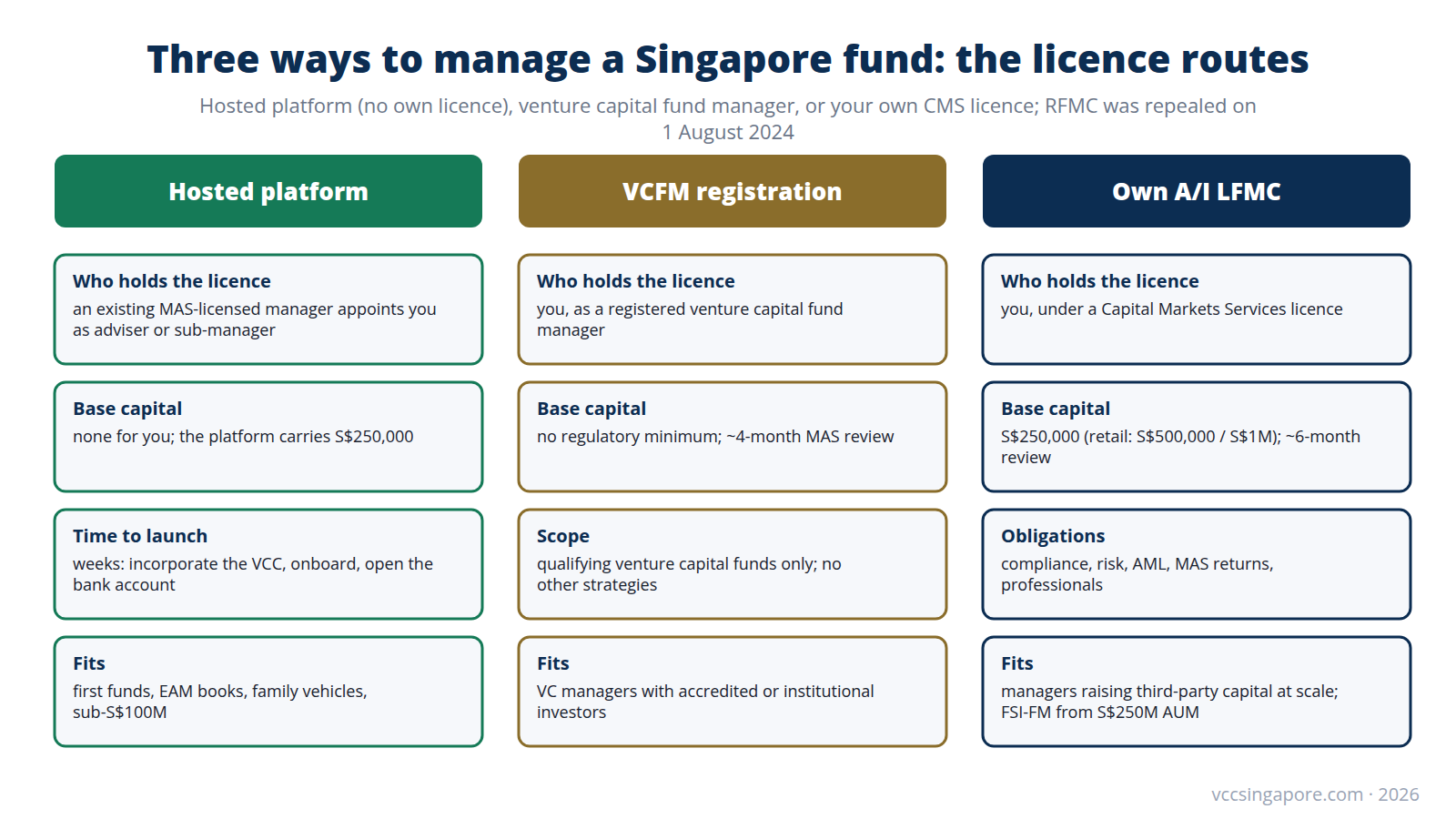
How do you set up a fund management company in Singapore?
The path is consistent across tiers, even though the numbers differ. In outline:
- Incorporate a Singapore company with ACRA — a private limited company is the usual FMC vehicle.
- Decide your licence tier — driven by who your investors are (accredited/institutional only, or also retail) and whether your strategy is venture capital.
- Assess regulatory capital for the selected category. Base-capital and risk-based requirements differ; the VCFM regime does not impose the same prudential requirements as A/I and Retail LFMCs.
- Staff it with at least two Singapore-based professionals and fit-and-proper directors, shareholders and representatives.
- Build the compliance infrastructure — compliance function, risk management, AML/CFT framework, professional indemnity insurance.
- Apply to MAS via the Form 1 application (or the VCFM licence application), then clear the review — roughly six months for an LFMC, around four for a VCFM.
The full licensing mechanics — the Form 1, fees and timeline — sit on the CMS licence guide and the wider fund management licence overview. This page focuses on choosing the tier and, crucially, on what happens after you are licensed.
FMC licence tiers: the A/I LFMC, Retail LFMC and VCFM
The applicable category depends on the investors served and the investment activities undertaken. The table distinguishes accredited/institutional, retail and venture-capital arrangements, and identifies the repealed RFMC regime.
| FMC type | Who it serves | Base capital | Risk-based capital | SG-based pros | MAS review |
|---|---|---|---|---|---|
| A/I LFMC (CMS) | Accredited & institutional investors only | S$250k | ≥120% | ≥2 | ~6 months |
| Retail LFMC (CMS) | Retail + accredited + institutional | S$500k (S$1m if retail CIS) | ≥120% | ≥2 | ~6 months+ |
| VCFM | Qualifying venture capital funds | No regulatory minimum | Not applied | ≥2 | ~4 months |
| RFMC | Repealed 1 August 2024 — transitioned to A/I LFMC via Form 1AR; no longer available to new managers | ||||
Accredited and institutional investor LFMCs
Read the analysis and conditions
An A/I LFMC serves accredited and institutional investors. Its base-capital floor is S$250k, alongside the applicable risk-based capital requirement. The former RFMC regime had a S$250 million AUM cap; that historical cap should not be confused with the A/I LFMC’s base capital. The firm must maintain resources appropriate to its activities. See establishing an independent asset manager.
Retail LFMCs
Read the analysis and conditions
A Retail LFMC may additionally serve retail investors. Because retail money carries more investor-protection obligations, the bar rises: S$500k base capital (and S$1m where the manager runs a retail collective investment scheme), heavier compliance, audit and disclosure duties, and a track-record expectation. Most new managers start A/I and only move to retail when a genuine retail product justifies the extra cost.
Venture capital fund managers
Read the analysis and conditions
The VCFM regime is a simplified licensing framework for managers of qualifying venture-capital funds. It has no regulatory minimum base capital. The page’s indicative review estimate is around four months, but timing depends on the application. The licence is confined to qualifying activities; a change in strategy may require a different licensing category. See VCFM and the RFMC repeal.
Assessing the appropriate licensing category
The decision is driven by two questions, answered in order. First, who are your investors? If you will take only accredited and institutional money, you are in A/I LFMC territory. If you genuinely intend to serve retail investors, you need a Retail LFMC and the higher S$500k–S$1m capital and compliance bar that comes with it. Second, what do you invest in? If your strategy is firmly qualifying venture capital, the VCFM licensing regime is the lean route — no minimum base capital and a faster review — but only if you are confident the strategy stays within VC limits, because drifting beyond them forces a conversion to a full LFMC. Most boutiques land on the A/I LFMC: it is the broadest tier that does not carry the retail burden. Getting this choice right at the outset matters, because moving tiers later means a fresh application and, often, fresh capital.
Base capital, the two professionals, and RBC 120%
Assess capital, staffing and financial-resources requirements for the proposed category. The table above distinguishes requirements that do not apply uniformly to every type of manager.
- Base capital is a floor of paid-up capital and reserves the company must hold — S$250k (A/I), S$500k–S$1m (retail), none prescribed for a VCFM. It is held, not spent.
- At least two Singapore-based professionals — typically a CEO/director and a representative, genuinely resident and running the business from Singapore. MAS expects real substance, not a nameplate.
- Risk-based capital. The 120% requirement described here concerns A/I and Retail LFMCs. VCFMs are excluded from the financial-resources requirements in Part III of the relevant regulations.
Identify both admission requirements and continuing obligations for the chosen category, and incorporate them into the firm’s operating budget and monitoring process.
Compliance for a fund management company in Singapore: the ongoing obligations
A licensing application is one stage in establishing the firm. Continuing compliance, risk management and reporting require staff, systems and oversight throughout its operation. The checklist below identifies the main workstreams to plan.
| Obligation | What it involves | Cadence |
|---|---|---|
| Maintain base & risk-based capital | Maintain the capital requirements applicable to the licensing category; the VCFM regime is excluded from the Part III financial-resources requirement. | Continuous |
| AML/CFT framework | Customer due diligence, screening, transaction monitoring, suspicious-transaction reporting, an appointed AML/CFT officer | Continuous + periodic review |
| Compliance function & manual | A documented compliance programme and manual, monitoring, and a compliance officer (independent or outsourced for smaller FMCs) | Continuous |
| Risk management | Independent risk-management framework appropriate to the strategy and AUM | Continuous |
| Annual statutory audit | Independent audit of the FMC and submission of audited accounts to MAS | Annual |
| Professional indemnity insurance | PI cover appropriate to the business | Annual renewal |
| MAS regulatory reporting | Periodic financial returns, the annual declaration, and prompt notification of material changes or breaches | Periodic + ad-hoc |
| Fit-and-proper & representatives | Keep directors, shareholders and appointed representatives fit-and-proper; lodge changes with MAS | Ongoing |
| Conduct & disclosure | Conflicts management, fair dealing, client reporting and record-keeping | Continuous |
Read the analysis and conditions
The cost of maintaining these functions belongs in the operating budget. Compare internal and outsourced support, and establish the obligations that remain with the firm under either arrangement.
Resourcing continuing compliance
Read the analysis and conditions
It is tempting to treat the licence as the finish line and compliance as an afterthought. The reverse is true. Clearing the application is a one-off project; the compliance obligations are a permanent overhead that scales with your activity and never goes away. The AML/CFT regime alone is substantial — you must risk-rate clients, screen them against sanctions and PEP lists, monitor for unusual activity, file suspicious-transaction reports, and appoint a responsible officer. On top of that sit independent risk management, a live compliance manual that is actually followed (not a binder on a shelf), an annual audit, and a stream of MAS reporting with hard deadlines. Smaller FMCs frequently outsource the compliance and risk functions to a specialist provider precisely because building them in-house is disproportionate at low AUM. Whichever way you resource it, this is a recurring cost and a recurring management responsibility — and a breach is reportable to MAS, not something you can quietly fix later. For managers below a certain scale, the honest conclusion is often that the compliance overhead, not the licence itself, is what makes a standalone FMC uneconomic — which is the case for the alternative below.
Set up your own FMC, or launch under one?
Describe the proposed strategy, investor base, staffing and timetable to request an introduction for fund management or establishment support.
Discuss your requirements →Appointing an existing fund manager
A VCC sponsor can compare establishing a management company with appointing an existing permissible fund manager. The appointed firm remains responsible for its regulated management activities. Its licence does not transfer to the sponsor, whose own activities and obligations require separate assessment.
Read the analysis and conditions
Define any advisory or sub-management role in the appointment documents and assess its licensing implications. Compare the provider’s fees and service scope with the resources required for a separate licensed firm. The appointed-manager comparison sets out the relevant operating considerations.
How the FMC connects to the rest of your setup
The FMC is one of the building blocks in how to start a fund in Singapore, sitting underneath the VCC vehicle. Once the manager question is settled, most funds layer on a 13O or 13U tax incentive and appoint their service providers. The detailed licence mechanics live on the CMS licence guide and the fund management licence overview; VC managers should also read VCFM & the RFMC repeal.
Frequently asked questions
How do you set up a fund management company in Singapore?
Establish a Singapore company, assess the planned activities and investor base, and apply for the appropriate CMS licence. A/I and Retail LFMCs have different capital requirements; qualifying venture-capital managers can apply under the VCFM regime. Staffing, compliance and prudential requirements must be assessed for the selected category. The 120% risk-based capital requirement does not apply universally to VCFMs.
What are the compliance requirements for a fund management company in Singapore?
Plan for continuing AML/CFT controls, compliance policies, risk management, reporting and fit-and-proper obligations. Audit, insurance and prudential requirements should be checked against the licensing category and licence conditions. The VCFM regime does not impose the same capital requirements as A/I and Retail LFMCs.
What is the minimum capital to start a fund management company in Singapore?
An A/I LFMC requires S$250k base capital. A Retail LFMC requires S$500k, rising to S$1m for management of a retail collective investment scheme. A VCFM has no regulatory minimum base capital and is excluded from the Part III financial-resources requirement; the 120% statement does not apply to every category.
Can I run a fund without setting up my own fund management company?
A VCC can appoint an existing permissible fund manager. The appointed firm remains responsible for regulated management; this does not authorise the sponsor to perform activities requiring its own licence. Compare the management agreement, responsibilities and fees with the cost of establishing a separate licensed firm.
VCC Singapore is an independent informational resource and is not a regulator, law firm or tax adviser. Licensing tiers, capital, headcount and compliance requirements are set by MAS and change periodically — confirm the current figures before acting. This page is general information, not legal, tax or financial advice.