
How Much Does a Singapore Family Office Cost?
An indicative budget for establishment, staffing and annual operations, with a comparison of dedicated and outsourced family-office arrangements.
A Singapore single family office typically costs S$300,000 to S$500,000 to set up and S$300,000 to S$1.5 million a year to run. There is no legal minimum net worth, but the running cost means a dedicated office rarely makes economic sense below roughly S$20–50 million of investable assets — and the 13O incentive sets a hard S$20 million floor in designated investments for 13O/13OA on the single-family-office track (S$50 million for 13U), tested at application and at each basis-period end. Below those levels a multi-family office or external asset manager almost always delivers more value per dollar.
Part of our family office in Singapore hub.
How much does it cost to set up a family office in Singapore?
Budget S$300,000 to S$500,000 for setup. The main components:
- Legal and structuring — designing the family office and fund structure, drafting constitutional documents.
- Incorporation — registering the family office entity and a fund vehicle, usually a VCC, with ACRA, plus directors and a company secretary.
- Tax-incentive application — preparing and filing the 13O or 13U application with MAS.
- Licensing (if applicable) — for an MFO or a family that builds its own licensed manager rather than relying on the SFO class licensing exemption.
- First-year administration and audit — fund administrator, auditor and custody onboarding.
What is the annual running cost?
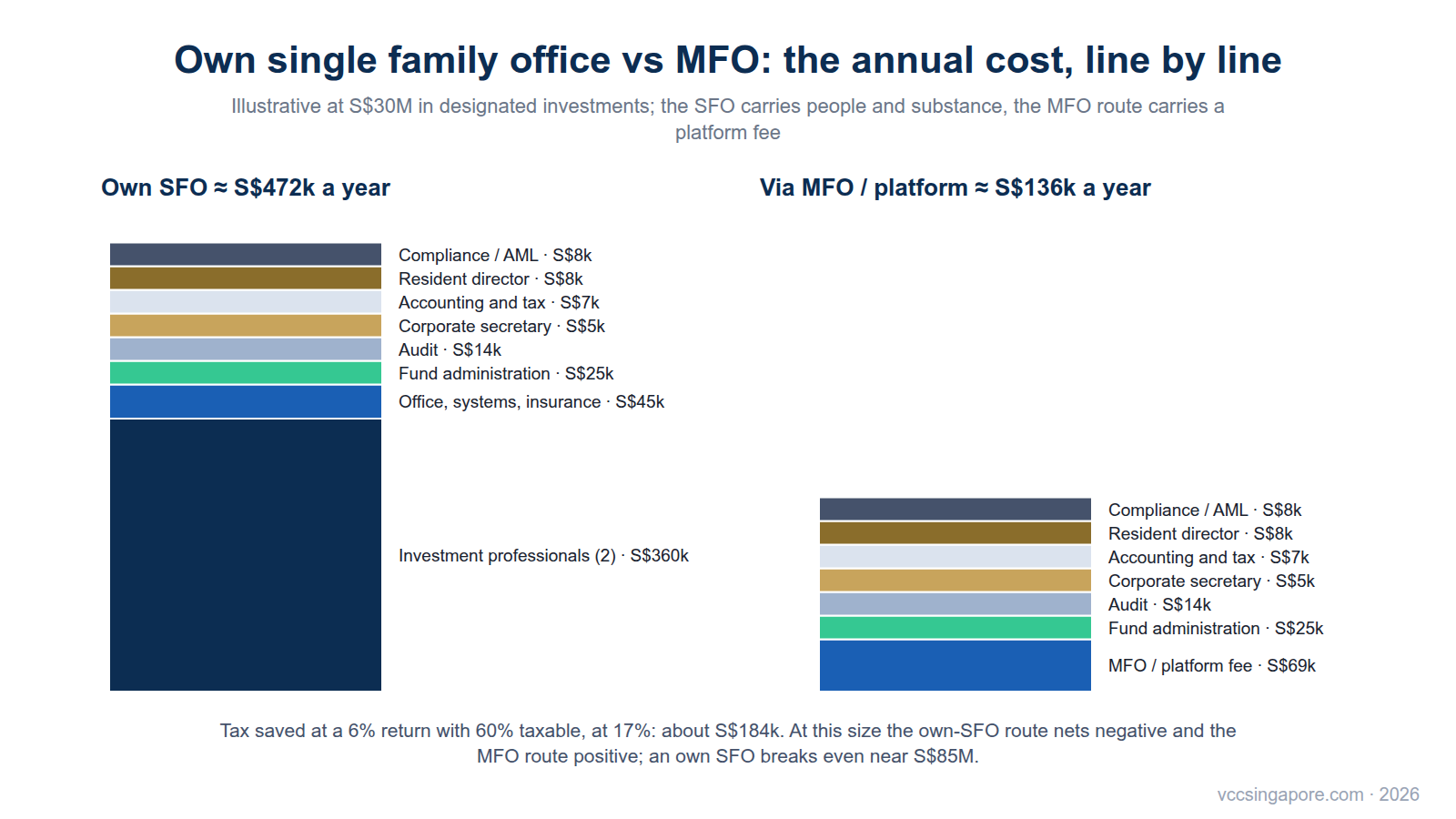
The annual run-rate is typically S$300,000 to S$1.5 million , and headcount dominates. The tax incentive forces you to employ investment professionals in Singapore (two for 13O, three for 13U), all Singapore tax-resident and above the MAS salary floor — that alone can be the bulk of the budget. Then come office space, audit, fund administration, custody, compliance and corporate secretarial services. The required local business spending (S$200k / S$500k / S$1M by AUM band) is largely satisfied by these genuine costs.
| Cost line | Setup (one-off) | Annual run-rate |
|---|---|---|
| Legal & structuring | Significant | Lower (ad hoc) |
| Incorporation (FO + VCC) | Yes | Renewal / secretarial |
| 13O/13U application | Yes | Ongoing compliance reporting |
| Investment professionals | Hiring | Largest line (2–3 staff, SG-resident salaries) |
| Office & operations | Fit-out | Rent, IT, admin |
| Audit, fund admin, custody | Onboarding | Recurring |
| Compliance | Setup | Recurring |
| Indicative total | S$300k–500k | S$300k–1.5M |
13O vs 13U vs multi-family office: a cost comparison
The single most useful way to budget is to compare the three routes a wealthy family actually chooses between — a 13O single family office, a larger 13U single family office, and outsourcing to a multi-family office (MFO). Setup and annual run-rate both climb with substance: 13U requires a third investment professional and more local spending than 13O, while an MFO trades a far higher cost base for a service shared across many client families. The ranges below are draft-level best-estimates for 2026.
| 13O Single Family Office | 13U Single Family Office | Multi-Family Office (MFO) | |
|---|---|---|---|
| Typical setup (one-off) | S$300k–500k | S$500k–800k | S$1.5M–5M |
| Typical annual run-rate | S$200k–400k | S$700k–1.5M | S$1.5M–5M |
| Minimum AUM | S$20M (end of each FY) | S$50M (application & each FY) | No statutory floor; commercial |
| Investment professionals | 2 (≥1 non-family) | 3 (≥1 non-family) | ≥2 (Singapore-based, LFMC) |
| Required local business spending | S$200k (tiered by AUM) | S$500k (tiered by AUM) | Carried as licensed-firm overhead |
| Licence | Exempt (SFO class exemption, notified to MAS) | Exempt (SFO class exemption, notified to MAS) | CMS licence required |
| Who bears the cost | The family alone | The family alone | Shared across client families (you pay a fee) |
| Best for | ~S$20–50M, building in-house | S$50M+ wanting institutional standing | Capability without the full overhead |
Read the analysis and conditions
Distinguish the cost of operating an MFO from the fee paid by a family using it. The table shows the MFO’s operating budget; client fees depend on the agreed service. For a family with around S$30M, compare the cost of a 13O office with the additional requirements of 13U and with an MFO mandate before selecting a structure.
What drives the cost of a Singapore family office?
The main budget variables are staffing, portfolio complexity, the number of entities and the extent of outsourcing:
- Headcount (the biggest lever) — the tax incentive forces Singapore-resident investment professionals above the MAS salary floor: two for 13O, three for 13U. Each experienced hire can run into six figures a year, so the jump from 13O to 13U is largely a headcount jump.
- Required local business spending — a hard floor tiered by AUM: S$200k below S$250M, S$300k from S$250M–S$2B, and S$500k above S$2B. It is usually absorbed by genuine salary, office and service costs rather than added on top.
- Asset mix and complexity — listed-only portfolios are cheap to administer; private equity, real estate, direct deals and multi-currency books raise legal, valuation, audit and fund-administration cost.
- Structure — a single VCC with one sub-fund is cheaper than an umbrella with several ring-fenced sub-funds for different branches or asset classes.
- Building a licensed management company entails licensing, capital, staffing and compliance costs. Appointing an existing permissible fund manager avoids building that company, but the manager’s fees remain. An SFO licensing exemption does not remove the VCC’s manager requirement.
- Provider tier and jurisdiction reach — Big-4 and premium law firms cost more than boutiques; multi-bank custody and cross-border reporting add recurring fees.
- Residency ambitions — pursuing PR via the Global Investor Programme pushes AUM and deployment far above the tax-incentive minimums and raises the whole cost base accordingly.
What is the minimum net worth to justify a family office?
There is no statutory minimum net worth. With S$10M of assets, annual costs of S$500k equal 5% of AUM; at S$30M they equal about 1.67%, and at S$50M, 1%. These costs must be weighed against control, privacy, tax efficiency and succession requirements. The indicative S$20–50M investable-asset range is a planning reference, not a universal break-even point. Compare a dedicated office with an MFO mandate.
Is a family office cheaper than using a multi-family office?
For most families below the S$20–50M range, no — an MFO or EAM spreads infrastructure, compliance and investment-team cost across many clients, so you pay fees rather than carry the full fixed overhead. A dedicated SFO only becomes cost-efficient once AUM is large enough that the run-rate is a small fraction of returns. The full comparison is on the SFO vs MFO page.
Discuss your family-office budget
Outline the asset mix, management arrangement and required services. Request a specialist introduction to prepare an establishment budget and assess recurring operating costs.
Get a tailored estimate →Frequently asked questions
How much does it cost to set up a family office in Singapore?
Roughly S$300,000 to S$500,000, covering legal and structuring, incorporating the family office and a fund vehicle such as a VCC, the 13O/13U application, any licensing work, and first-year administration and audit.
What is the annual running cost of a Singapore family office?
Typically S$300,000 to S$1.5 million, dominated by the investment professionals the tax incentive requires (two for 13O, three for 13U), then office, audit, fund admin, custody and compliance.
What is the minimum net worth to justify a Singapore family office?
No legal minimum, but the economics rarely work below about S$20–50 million of investable assets. The 13O incentive sets a S$20M AUM floor and 13U a S$50M floor.
Is a family office cheaper than using a multi-family office?
For most families below S$20–50M, an MFO or external asset manager is cheaper because it spreads cost across clients. A dedicated SFO only becomes cost-efficient once AUM makes the fixed run-rate a small fraction of returns.
VCC Singapore is an independent informational resource and is not a regulator, law firm or tax adviser. Costs are draft-level estimates and vary by provider and circumstance; tax thresholds are set by MAS and IRAS and change periodically. This page is general information, not legal, tax or financial advice.