
13O, 13OA and 13U: commercial and family-office conditions
The minimum assets required under Section 13O depend on the fund’s classification. MAS Circular FDD Cir 05/2026, dated 31 July 2026, sets out separate conditions for non-SFO funds managed by licensed fund managers and single-family-office funds. The S$5 million and S$20 million thresholds refer to different tracks. This comparison covers their entry requirements, ongoing conditions and implications for structuring.
Companion (2 September 2026): the minimum-AUM floors explained — why S$20 million on the SFO track and S$5 million on the commercial track, and how designated investments are measured.
Fund classification and applicable conditions
The statute is shared; the operating rules are not. A non-SFO fund — the circular's term for funds "typically managed by a licensed fund management company", with third-party capital or a bona fide intention to raise it — qualifies for 13O/13OA from S$5 million in designated investments at application and 13U from S$50 million, with no annual minimum AUM condition at all (removed retroactively from 1 January 2025) and no capital deployment requirement. An SFO fund — assets primarily from one family, managed by a licensing-exempt single family office — faces S$20 million (13O/13OA) or S$50 million (13U) tested at application and every basis-period end, higher local-spending tiers, a mandatory non-family hire, a private-banking account condition, and the capital deployment requirement: the lower of 10% of AUM or S$10 million invested into Singapore-linked assets. If you manage third-party money under a CMS licence, the "local investment mandate" you may have read about on MAS's family-office page simply does not apply to your fund.
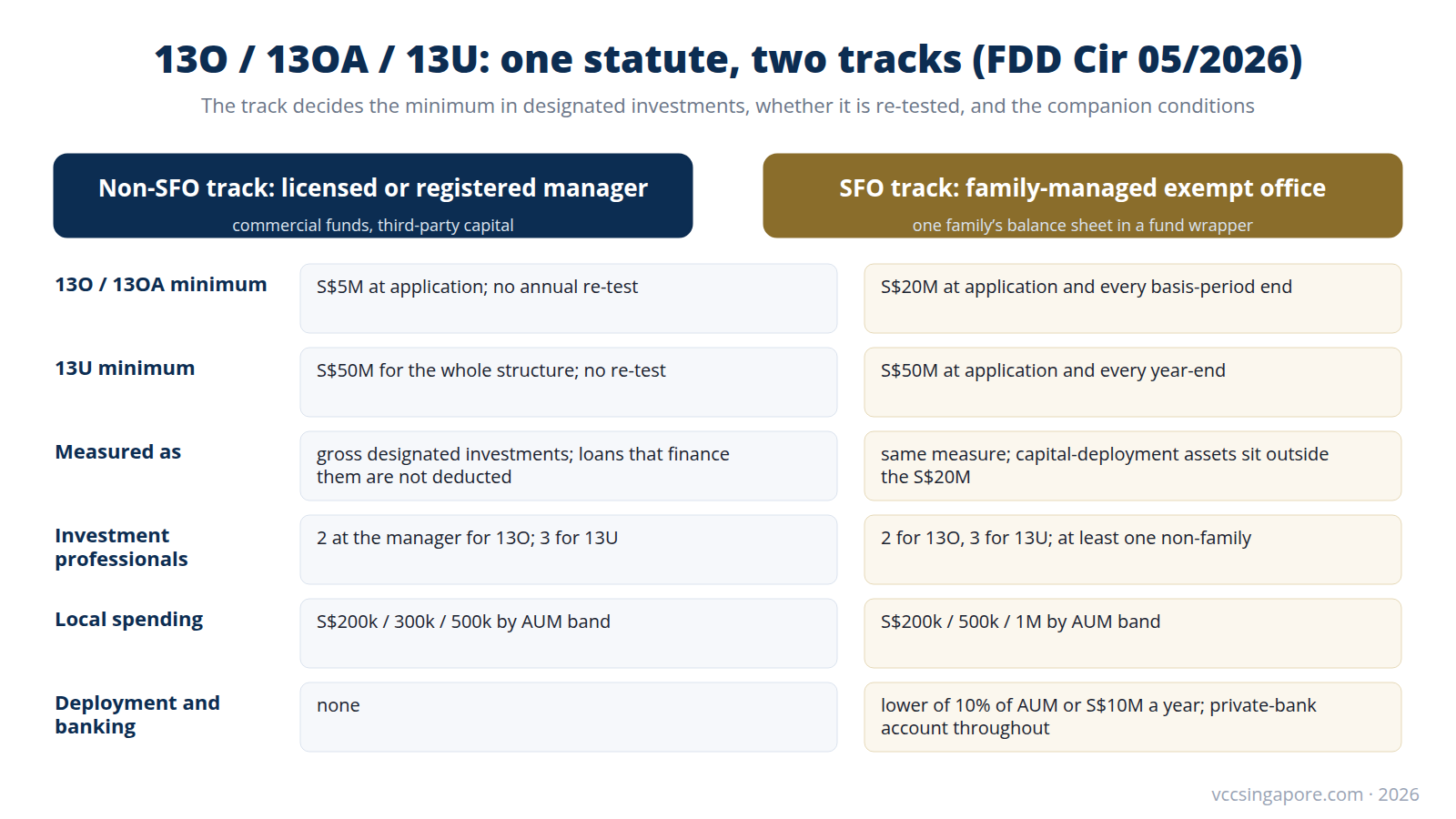
Conditions by track
| Condition | Non-SFO track (commercial) | SFO track (family office) |
|---|---|---|
| Manager | CMS-licensed or exempt FMC | SFO exempt under para 5(1)(ba), SF(LCB) Regulations |
| Capital base | Third-party investors, or bona fide intention to raise (MAS can revoke if never evidenced) | Assets primarily originated from members of one family |
| Min AUM in DI — 13O/13OA | S$5M at application; grace to the end of the 3rd YA's basis period; no annual re-test | S$20M at application and every year-end |
| Min AUM in DI — 13U | S$50M at application; no annual re-test | S$50M at application and every year-end |
| Investment professionals — 13O/13OA | 2 qualifying IPs at the FMC (transitional: enforced from YA 2028) | 2 at the SFO, ≥1 non-family; may apply with 1, complete by end of first YA's basis period or award revoked from day one |
| Investment professionals — 13U | 3 qualifying IPs at the FMC | 3 at the SFO, ≥1 non-family; may apply with 2 |
| Spending condition | Tiered LBS : S$200k / S$500k / S$1M by AUM band | Tiered local spending: S$200k / S$500k / S$1M — top tiers partially satisfiable via eligible donations and blended-finance grants (grants counted 2×) above LBS floors of S$300k / S$500k |
| Capital deployment requirement | None | Lower of 10% of AUM in DI or S$10M into three option classes, with 2× multipliers for SG-listed equities, substantially-SG equity funds, blended finance and unlisted SG operating companies |
| Banking condition | None specific | Private banking account with an MAS-licensed FI at application and throughout |
| Closed-end fund treatment | Available as an opt-in election | Not available (non-SFO only) |
The demarcation is stated in the circular's own FAQ with unusual bluntness: "the conditions (e.g. minimum annual spending condition) applicable to an S13O/OA/U fund managed by a non-SFO differ from those applicable to an S13O/OA/U fund managed by an SFO."
Different operating requirements
Commercial funds manage third-party capital through a licensed manager; SFO funds manage a family’s assets through a licensing-exempt office. Their conditions reflect those different management arrangements. Commercial funds are subject to the third-party-capital test and manager-level staffing and spending requirements. SFO funds face higher entry requirements, annual AUM testing, local capital deployment, a private-banking relationship and a non-family investment professional. The August 2026 package removed the annual AUM test for non-SFO funds and introduced phased hiring and wider screening for SFO funds.
Classification and structuring considerations
Settled: the S$5M vs S$20M confusion. Competing advisers have cited both for years, each half-right. From the primary text: S$5 million is the non-SFO 13O/13OA entry; S$20 million is the SFO 13O/13OA minimum. Neither number is "the" 13O minimum without naming the track.
Settled: who bears the local investment mandate. The CDR lives exclusively in the SFO sections (Section 4, Annexes 6B/7B). Nothing in the non-SFO conditions (Section 3, Annexes 6A/7A) requires a commercial fund to invest a single dollar in Singapore assets.
Read the analysis and conditions
Trap one: the tracks don't blend at the manager level alone. A family that appoints a CMS-licensed manager (a multi-family office, say) to run its vehicle does not automatically escape SFO conditions — the classification turns on whose assets the fund holds and the licensing basis of the management arrangement. Conversely, per the circular's FAQs, a fund that changes manager type must apply for a new award (commencing on the submission date) and meet its new track's conditions. Structure first, then apply.
Trap two: family operating businesses. An SFO fund may hold the family's operating companies without limit — but those holdings do not count toward the S$20M/S$50M minimum, while they do count toward spending and CDR conditions if they qualify as designated investments. A family whose "fund" is mostly the business plus a thin liquid sleeve can fail the entry test while looking large on paper.
Trap three: vintages. The new SFO conditions bind awards approved on or after 1 August 2026 — but existing awards sit under their own condition sets (pre-18Apr22, 18Apr22, 5Jul23), each now also modified from the first basis period ending on or after 1 August 2026. Which rulebook governs your award depends on when you applied.
Shared ground: what both tracks keep
Whichever track, the architecture is common: exemption of specified income on designated investments, for the life of the fund once awarded (with the schemes under review before their 31 December 2029 sunset — existing awards continue regardless); economic conditions assessed year by year, so a missed year costs that year's exemption rather than the award, while non-economic breaches can cost the award itself; GST remission and withholding-tax exemption alongside; and, since January 2025, welcome loosenings for everyone — funds no longer need to be newly set up, and locked investment-strategy conditions are gone (update MAS for information, not approval). The 5% cap on physical investment precious metals in the designated-investment list is removed from 1 August 2026 for all funds.
Discuss your fund’s classification
Outline the manager arrangement, the source of the fund’s capital and the date of any existing award. Request an introduction to a licensed fund manager or family-office specialist to assess the applicable entry requirements, spending conditions and capital deployment obligations.
Discuss your requirements →Does the capital deployment requirement apply to funds managed by CMS-licensed fund managers?
No. Under FDD Cir 05/2026, the capital deployment requirement — investing the lower of 10% of AUM or S$10 million into Singapore-linked investments — appears only in the SFO-fund conditions (Section 4 and Annexes 6B/7B). The non-SFO conditions for funds managed by licensed fund management companies (Section 3 and Annexes 6A/7A) contain no CDR and no local investment mandate. A commercial fund's Singapore-facing obligations are the tiered local business spending and investment-professional conditions.
What is the difference between the normal 13O/13U schemes and the SFO versions?
Same statute, different condition sets. Sections 13O, 13OA and 13U of the Income Tax Act cover both, but MAS now applies two demarcated tracks: non-SFO funds (managed by a licensed FMC, requiring third-party capital or a bona fide intention to raise it) enter 13O/13OA at S$5 million and 13U at S$50 million with no annual AUM re-test and no CDR; SFO funds (family assets, licensing-exempt manager) enter at S$20 million (13O/13OA) or S$50 million (13U) tested at every year-end, plus the CDR, a private-banking account condition, higher spending tiers and a mandatory non-family investment professional.
What are the minimum AUM requirements under 13O and 13U in 2026?
Track-dependent. Non-SFO funds: S$5 million in designated investments at application for 13O/13OA (with a grace period to the end of the third year of assessment's basis period) and S$50 million at application for 13U — with no annual minimum thereafter, retroactive to 1 January 2025. SFO funds: S$20 million for 13O/13OA and S$50 million for 13U, required at application and at the end of every basis period. This resolves the S$5M-versus-S$20M confusion across the web — both are right, for different tracks.
What are the SFO fund conditions for awards approved from 1 August 2026?
Investment professionals: two for 13O/13OA (at least one non-family; may apply with one and complete hiring by the end of the first year of assessment's basis period), three for 13U (apply with two). Minimum AUM in designated investments of S$20 million (13O/13OA) or S$50 million (13U) at application and each year-end. Tiered local spending of S$200,000 / S$500,000 / S$1 million by AUM band, partially satisfiable above a floor through eligible donations and double-counted blended-finance grants. The capital deployment requirement. And a private banking account with an MAS-licensed institution at application and throughout.
What happens if a fund changes from an SFO manager to a licensed fund manager, or vice versa?
The award does not travel across tracks. Per the circular's FAQs, a change of manager type means applying for a new award — with the new award commencing on the application submission date to avoid a coverage gap — and the fund then meets the condition set of its new track. The two tracks' conditions differ explicitly, so model the economics before restructuring.