
Minimum AUM for a Singapore VCC: legal, tax and operating requirements
The VCC statute does not impose a minimum AUM. Tax incentive requirements and operating costs create separate thresholds: S$5 million, S$20 million or S$50 million may apply depending on the scheme and track. This guide distinguishes those conditions and explains how AUM in designated investments is measured.
This page sits under the VCC requirements hub. For the full two-track conditions see one statute, two tracks; for what counts as an asset, see designated investments and specified income.
The short answer
A Variable Capital Company has no legal minimum capital: the VCC Act deems its paid-up capital to equal its net asset value at all times, so a VCC can be incorporated and run with whatever its investors subscribe. The minimums people mean when they ask this question are the fund tax incentive floors, and since MAS formally split the schemes into two tracks there are two answers. A fund managed by a CMS-licensed fund management company (the non-SFO, commercial track) needs S$5 million of designated investments at application for Section 13O or 13OA, and S$50 million for 13U — with no annual re-test. A single family office fund needs S$20 million for 13O or 13OA and S$50 million for 13U, tested at application and at the end of every basis period. Beneath both sits the fourth floor: the running cost of a regulated fund, which is why very few VCCs operate below S$5 million even where the law would allow it.
Statutory capital requirements
Unlike a private limited company with its nominal S$1 share, a VCC does not carry a fixed capital figure. Its capital is variable by design: it issues and redeems shares at net asset value, and the Act deems paid-up capital equal to NAV so that redemptions never require a capital-reduction process. The statutory conditions for running a VCC are about governance, not size — a Singapore-resident director, a Permissible Fund Manager, a regulated custodian for authorised schemes, audited accounts and AML obligations. Read those in the governance and directors guide. Nothing in the VCC Act prevents a S$2 million fund; the reasons not to run one appear on the next three floors.
Floor two: the tax-award minimums, by track
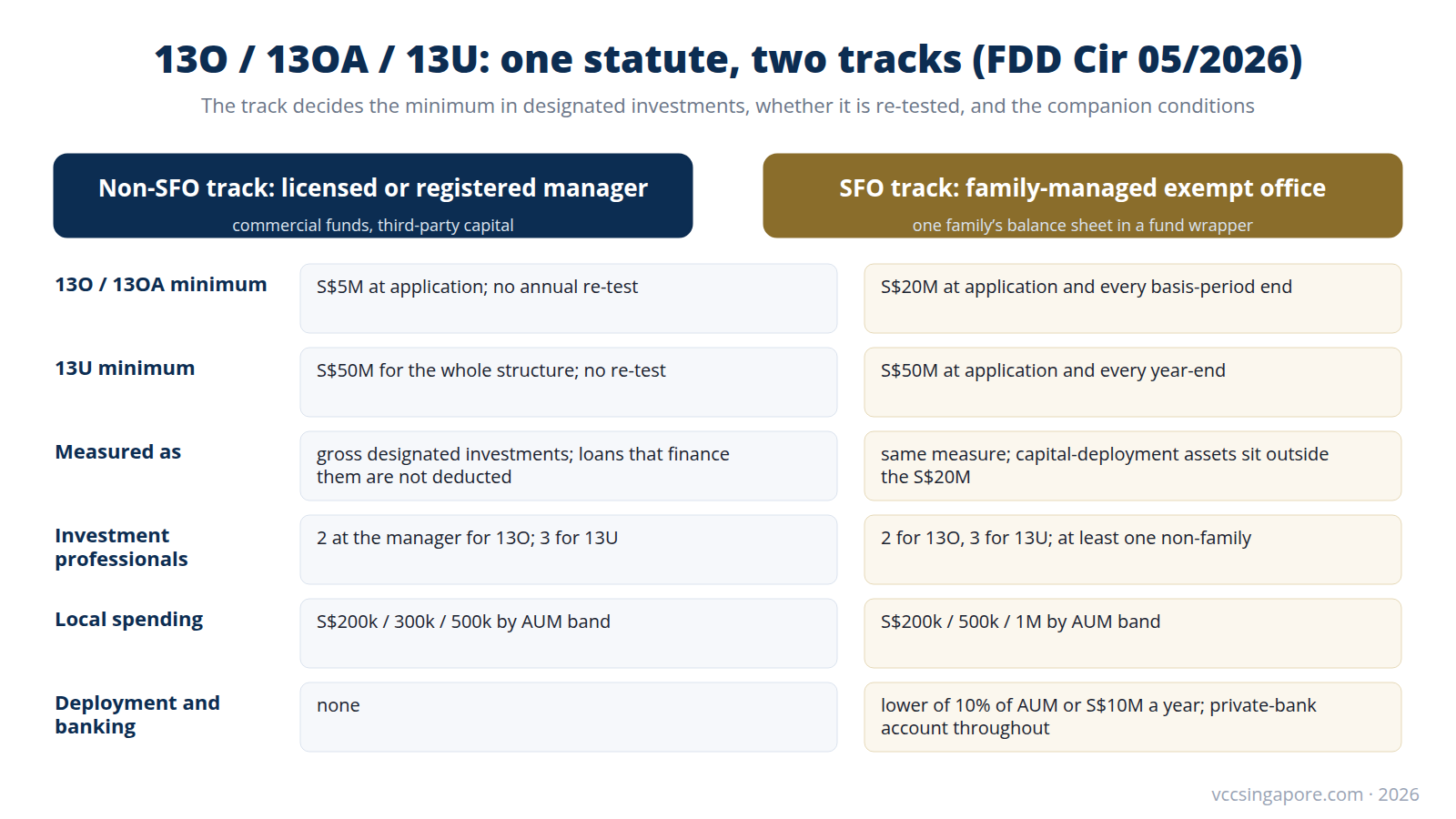
The fund exemptions under Section 13O, 13OA and 13U are where a hard number appears, and since FDD Cir 05/2026 the number depends on who manages the fund.
| Scheme | Non-SFO track (licensed manager) | SFO track (single family office) |
|---|---|---|
| 13O / 13OA minimum | S$5 million in designated investments at application; no annual re-test (the year-end test introduced on 1 January 2025 was removed retroactively by the 2026 circular) | S$20 million in designated investments at application and at the end of every basis period |
| 13U minimum | S$50 million at application, assessed for the whole structure (master-feeder, SPVs included); no annual re-test | S$50 million at application and every basis-period end |
| Where the number applies | The fund vehicle — an umbrella VCC is assessed as one entity | The family’s fund vehicle |
| What a shortfall costs | Nothing after entry — there is no ongoing size condition | The exemption for that year of assessment, not the award itself (see which SFO rulebook binds your award) |
| Companion conditions | Local business spending tiered S$200,000 / S$300,000 / S$500,000 by AUM; at least two qualifying investment professionals at the manager (enforced from YA 2028 for 13O); no capital deployment requirement | Higher spending tiers; at least one non-family investment professional; the capital deployment requirement (lower of 10% of AUM or S$10 million into Singapore-linked assets); a private-banking account with an MAS-licensed bank throughout |
Read the analysis and conditions
Two refinements matter in practice. Under the closed-end fund election, a drawdown fund may count total committed capital, called and undrawn, toward its entry floor — a private-equity or credit fund does not have to wait for capital calls to apply. And a 13U structure is measured collectively: MAS removed the requirement for each additional SPV or feeder to meet its own size and spending conditions, so the S$50 million is a structure-level figure (see 13U for structures).
Measuring AUM in designated investments
Before 5 July 2023 the family-office rule spoke of a “minimum fund size”: S$10 million at application with a two-year grace period to reach S$20 million, understood in practice as a net figure. The 2023 conditions replaced that with “AUM in Designated Investments” — S$20 million or S$50 million at application and throughout the award — and the 2025 fund-scheme amendments carried the same measure into the commercial track at S$5 million. The change looks like tightening (the grace period went) but the measurement itself became more accommodating in three ways.
| Feature | Old “fund size” reading | AUM in designated investments (current) |
|---|---|---|
| Basis | Net asset value: assets less liabilities | Gross asset value of the fund’s designated investments |
| Borrowings | Reduced the figure | Loans taken to finance designated investments — including shareholder loans — need not be treated as liabilities in the calculation |
| Timing | S$10 million at entry, S$20 million within two years (SFO) | Full amount at application; SFO funds re-tested each year-end, commercial funds not re-tested at all |
| What counts | Broadly everything the fund held | Only assets on the designated-investments list: listed and unlisted shares, bonds and notes, fund units, derivatives, deposits with banks and approved financial institutions, certain loans and structured products, non-Singapore real estate and certain commodities |
| What does not count | — | Direct Singapore residential or commercial property and Singapore property-holding companies; and, for SFOs, the Singapore-linked assets used to satisfy the capital deployment requirement, which sit alongside the S$20 million rather than inside it |
Read the analysis and conditions
The net effect is a measure that rewards a real investment portfolio and ignores how it is financed. A family that seeds its fund with S$15 million of equity and a S$6 million shareholder loan, fully invested in listed securities, holds S$21 million of designated investments and clears the SFO floor; under a net-asset reading it would not have. The price is discipline about what is held: a Singapore condominium in the fund, or a large cash balance outside a bank deposit, does nothing for the test.
Why S$20 million for a family office and S$5 million for a licensed manager
The four-to-one gap is the most misread number in Singapore fund tax, and it is not arbitrary. MAS explained the 2023 tightening as “increasing the size of the funds, sharpening the fund manager’s expertise and boosting investments in the local economy”, and the 2025 amendments as ensuring “economic substance in Singapore for incentivised fund structures”. Each floor answers a different policy question.
| Policy purpose | How the SFO floor (S$20M, re-tested) serves it | How the non-SFO floor (S$5M, entry-only) serves it |
|---|---|---|
| Minimum viability — the exemption should go to funds that can carry a real operation | An SFO fund must spend at least S$200,000 a year locally and employ investment professionals above a salary floor. At S$20 million that is roughly 1–1.5% of assets; at S$5 million it would be 4% and more — a structure that consumes itself | Substance is carried by the licensed manager, which already holds S$250,000 base capital, MAS oversight and its own professionals across many funds; the fund need only prove bona fide scale at entry |
| Business spending that scales — Singapore’s return on the exemption | Tiered local spending rises with AUM, and the floor guarantees the lowest tier is affordable; donation top-ups apply above hard floors | Tiered LBS of S$200,000 / S$300,000 / S$500,000 by AUM, with a transitional S$200,000 total-spending test until YA 2028 (LBS guide) |
| Stable employment — the family-office route was built to create jobs | At least one non-family investment professional, Singapore tax-resident and paid above the floor; a S$20 million book can sustain that payroll through a bad year, a S$5 million book cannot — hence the annual re-test | At least two qualifying professionals at the fund management company, policed through the manager’s licence rather than the fund |
| Anchoring capital — keeping assets, not just paperwork, in Singapore | Capital deployment requirement: the lower of 10% of AUM or S$10 million into Singapore-linked assets each year; a supervised private-banking relationship | None at fund level — commercial funds raise third-party capital and invest by mandate; the policy interest is the manager’s presence |
| Why the re-test differs | A family controls its own AUM and can top up; the annual test prevents a family office from decaying into a letterbox once the award is granted | Third-party AUM moves with markets and redemptions the manager does not control; an annual cliff-edge would punish performance and redemptions, so the 2026 circular removed it and left substance to the manager |
Read the analysis and conditions
The pattern is consistent: the SFO track buys a personal exemption for one family’s balance sheet, so the state asks for a bigger ticket, local jobs and local deployment, checked every year. The commercial track supports an industry that already answers to MAS through its licence, so the fund-level bar is lower and static. Read the two as different bargains, not different levels of generosity. The growth of single family offices — from around 400 in 2020 to more than 2,000 by the end of 2024 — is the backdrop: the floors rose precisely because volume made screening for substance necessary.
The economics of operating a fund
Even where an award is available at S$5 million, the fund has to pay for itself. The fixed costs of a VCC — audit per sub-fund, administration, corporate secretary, resident director, a manager or platform fee — do not scale down to zero. Our cost calculator puts a single sub-fund on a hosted platform at roughly S$60,000–90,000 a year; a standalone family office with its own staff runs from about S$300,000. The illustration below sets those costs against the value of the exemption, assuming a 6% annual return that would otherwise be taxable income at 17%.
| AUM in designated investments | Income at 6% | Tax avoided at 17% (illustrative) | Indicative annual running cost | Reading |
|---|---|---|---|---|
| S$5 million | S$300,000 | S$51,000 | S$60,000–90,000 (hosted sub-fund) | Below break-even; viable only as one sub-fund on an umbrella that shares costs |
| S$10 million | S$600,000 | S$102,000 | S$60,000–90,000 | Marginal; sensible for a manager building a track record |
| S$20 million | S$1.2 million | S$204,000 | S$60,000–90,000 (hosted) / S$300,000+ (own SFO) | Clearly worthwhile on a platform; the SFO floor is set where the family structure starts to pay for its own substance |
| S$50 million | S$3 million | S$510,000 | S$100,000–300,000+ | 13U territory; the exemption funds the substance several times over |
Read the analysis and conditions
Treat the middle columns as a ceiling rather than a forecast: Singapore has no capital gains tax, so a portfolio whose return is mostly long-term gains would owe less than 17% of its return even without an award. What the award adds is certainty — no argument about whether trading gains are income — and exemption of the interest, dividend and trading components that are plainly taxable. That certainty is worth more to an active credit or multi-strategy fund than to a buy-and-hold equity book, which is why active strategies tend to seek awards at smaller sizes.
The umbrella changes the arithmetic
An umbrella VCC is recognised as a single entity for income tax purposes regardless of how many sub-funds it has, files one income-tax return for the whole structure, and ring-fences each sub-fund’s income and losses so that one sub-fund’s loss can only be used against its own income. MAS grants the 13O or 13U award to the umbrella and assesses the size and spending conditions on the VCC as a whole, so sub-fund assets count together toward the floor — confirm the current administrative position with MAS for your structure. The practical consequence is that a manager with three S$3 million strategies, none of which could qualify alone, can hold all three as sub-funds of one umbrella that clears S$5 million with room to spare, shares one auditor and one board, and adds a fourth strategy later without a fresh application. That is the single largest reason the minimum is less of a barrier than it looks; see umbrella VCCs and ring-fencing.
Other floors you will meet on the way
- Private-bank onboarding. An SFO fund must hold a private-banking account with an MAS-licensed bank, and most banks’ effective minimums start around S$5 million — see private bank minimums.
- Manager-level incentives. The FSI-FM concessionary rate for the management company needs S$250 million under management and three investment professionals — a floor on the manager, not the fund.
- Residency-linked routes. The Global Investor Programme’s family-office option asks for S$200 million of assets with S$50 million deployed in Singapore — a different question, covered in family office and GIP.
- Older SFO awards. Funds awarded before July 2023 keep the vintage conditions they were granted under; the S$20 million-at-entry rule binds 5 July 2023 and later awards.
Assessing the requirements for your fund
- Assess the manager, investor base and applicable MAS award conditions together. A licensed manager is mandatory for the usual family VCC route, but appointing one does not automatically establish eligibility for the commercial non-SFO tax track. Do not substitute the S$5 million commercial entry threshold for the S$20 million SFO threshold.
- What do you hold? Count only designated investments, at gross value; move non-qualifying assets out of the vehicle before applying.
- How is it financed? Borrowing to fund designated investments does not reduce the measure; equity-only structures need the full amount subscribed.
- Drawdown or open-ended? Closed-end funds can enter on committed capital and escape any ongoing size test.
- Below the floor? Join an umbrella as a sub-fund, or run under a licensed manager’s platform until the book grows; the 13O application can follow later. Families below S$20 million are often better served by a multi-family office than by a sub-scale SFO.
Working out which floor applies to you?
Tell us how the fund will be managed, what it will hold and how much is committed. We will map the track, the measure and the realistic running cost for your structure — and connect you with MAS-licensed fund managers and platform providers where it fits.
Discuss your requirements →Frequently asked questions
Is there a legal minimum capital to incorporate or run a VCC?
No. The Variable Capital Companies Act sets no minimum capital; a VCC’s paid-up capital is deemed equal to its net asset value at all times, and the statutory conditions concern governance — a Singapore-resident director, a Permissible Fund Manager, audit and AML obligations — not size. The minimums people encounter come from the fund tax incentives and from the cost of running a regulated fund.
Is the 13O minimum S$5 million or S$20 million?
Both figures apply to different tracks. A fund managed by a CMS-licensed fund management company needs S$5 million in designated investments at application, with no annual re-test following the 2026 circular’s retroactive amendment from 1 January 2025. A single-family-office fund needs S$20 million at application and at the end of each basis period. Section 13U requires S$50 million on both tracks, assessed for the whole approved structure.
What counts toward “AUM in designated investments”?
The gross value of assets on the designated-investments list — listed and unlisted shares, bonds and notes, fund units, derivatives, deposits with banks and approved financial institutions, certain loans and structured products, non-Singapore real estate and certain commodities. Loans taken to finance those investments, including shareholder loans, need not be deducted. Direct Singapore property does not count, and for family offices the Singapore-linked assets used for the capital deployment requirement sit outside the S$20 million rather than inside it.
Why is the single-family-office minimum four times the licensed-manager minimum?
Because the two tracks are different bargains. The SFO exemption benefits one family’s own balance sheet, so MAS asks for scale that can sustain local spending, a non-family investment professional and annual capital deployment into Singapore, checked every year. A commercial fund already answers to MAS through its licensed manager, which carries base capital, professionals and oversight across many funds, so the fund-level floor is lower and tested only at entry.
Can several small sub-funds in an umbrella VCC pool together to meet the minimum?
In practice, yes. An umbrella VCC is a single entity for income tax purposes with one tax return, and MAS grants the 13O or 13U award to the umbrella and assesses the size and spending conditions on the structure as a whole, so sub-fund assets count together. Each sub-fund’s income and losses remain ring-fenced for tax computation. Confirm the current administrative position with MAS for your specific structure before relying on it.
- ACRA — VCC key features, eligibility and requirements (no minimum capital; paid-up capital equals NAV)
- IRAS — e-Tax Guide: Tax Framework for Variable Capital Companies (single-entity treatment, sub-fund ring-fencing)
- MAS — FAQs on the schemes for single family offices (13O/13U conditions)
- Drew & Napier — Updated criteria for Sections 13O and 13U applications for family offices (5 July 2023)
- DLA Piper — Amendments to the Singapore fund tax incentive schemes from 1 January 2025 (gross asset value; loans financing designated investments)