
Establishing a fund in Singapore
Fund structure, manager appointment, incorporation, service providers and tax assessment—from initial planning to first close.
Starting a fund in Singapore means assembling four things: a fund vehicle (most new funds use a Variable Capital Company, or VCC), a MAS-licensed fund manager to run it, a set of service providers (administrator, custodian, auditor, corporate secretary), and — optionally — a tax exemption under Section 13O or 13U. The single most important decision is the manager: every fund in Singapore must be managed by an entity that is licensed or regulated by the Monetary Authority of Singapore (MAS), but that entity does not have to be you.
This page is the hub for Pillar 3. It walks the whole process end to end and links down to the detailed pages on fund management licensing, setting up your own asset manager, the VCFM regime, timeline, steps and costs, and service providers and ACRA incorporation.
Fund formation and operating responsibilities
A fund is a pooled investment vehicle that takes money from investors and deploys it under a strategy. In Singapore that vehicle is wrapped in a legal structure — today, overwhelmingly a VCC, but historically a private limited company, a unit trust, or a limited partnership. The vehicle holds the assets; a separate, MAS-regulated fund manager makes the investment decisions. Investors subscribe for shares (or units), the manager invests, and gains flow back to investors at net asset value. Getting from idea to that first subscription — the "first close" — is what this guide covers.
Running a specific strategy? See the dedicated guides: setting up a private equity fund, a venture capital fund or a hedge fund in Singapore.
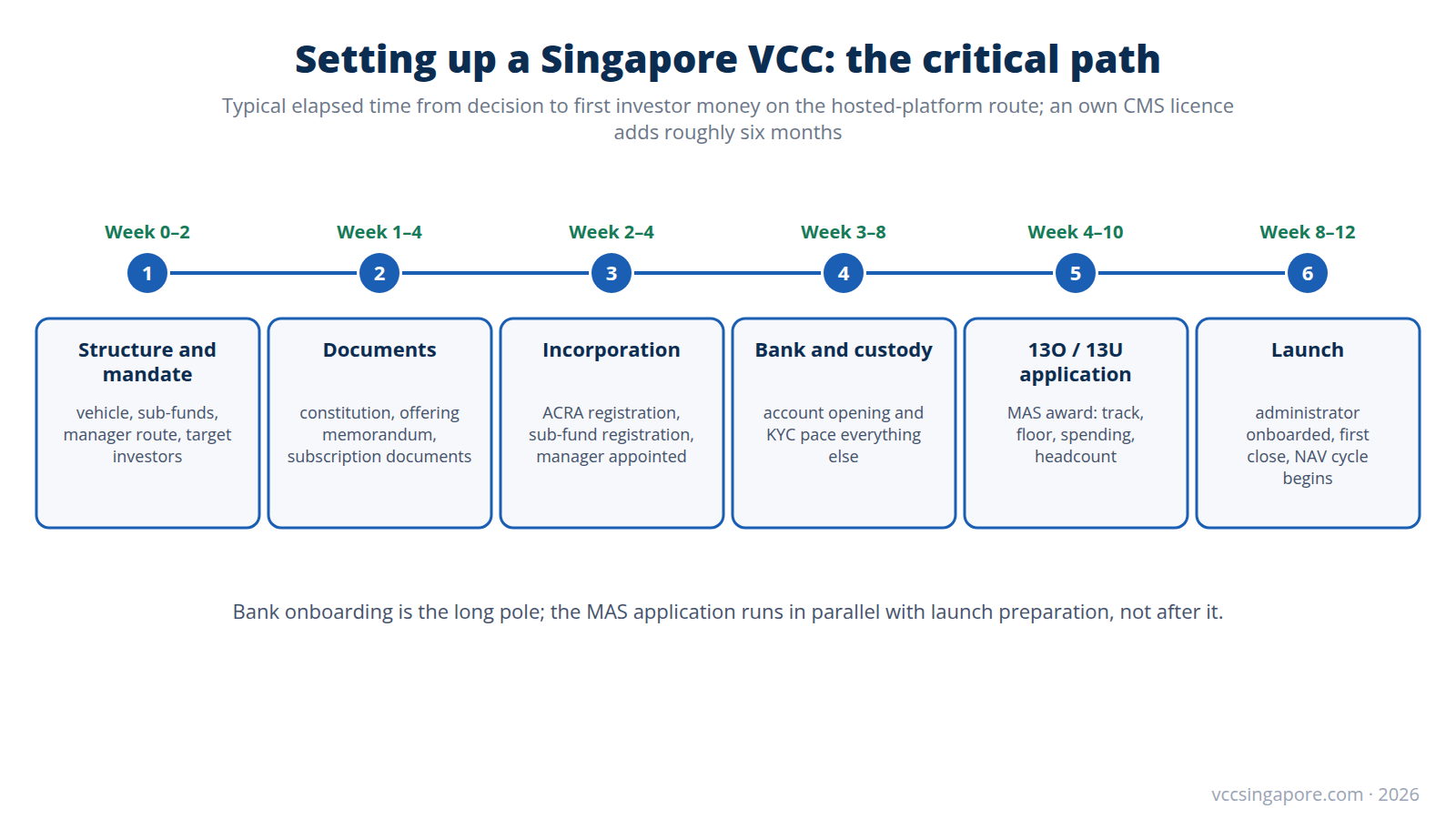
Step 1 — Choose your fund vehicle
For most new funds the answer is a VCC. It was purpose-built for funds: it can be a single standalone vehicle or an umbrella holding multiple ring-fenced sub-funds, it issues and redeems shares at NAV, and it can pay dividends out of capital. A VCC is also the cleanest fit for the 13O/13U tax incentives. The main alternatives — a private limited company, a Singapore limited partnership, or a unit trust — still exist, and the VCC-vs-Pte-Ltd trade-off is covered in VCC vs private limited company.
Step 2 — Select the management arrangement
This is where most founders over-spend and over-wait. Singapore law requires every fund to be managed by a MAS-licensed or MAS-regulated manager — for a VCC, this is the Permissible Fund Manager. You have two routes:
- Get your own licence. Apply to MAS for a Capital Markets Services (CMS) licence as a Licensed Fund Management Company (LFMC), or — for venture capital — register as a Venture Capital Fund Manager (VCFM). This gives you full control but costs at least S$250k of base capital, two Singapore-based professionals, an ongoing compliance function, and roughly six months of MAS review.
- Launch under an existing licensed manager. Appoint an established MAS-licensed Permissible Fund Manager to be the regulated manager of record. You keep day-to-day investment input, skip the capital lock-up, and skip the multi-month licensing wait. This is how a large share of new VCCs actually get to market — and it is covered in full on can you run a VCC without your own licence?
If you are weighing the two, read the decision matrix on running a VCC without your own licence before you commit capital to a licence application.
Step 3 — Incorporate the vehicle with ACRA
A VCC is incorporated through the Accounting and Corporate Regulatory Authority (ACRA), but unlike an ordinary company you must file via a registered corporate services provider — you cannot self-file a VCC. You will need a name, a registered Singapore office, at least one Singapore-resident director, and the appointment of your Permissible Fund Manager. The mechanics, required appointments and timing are detailed on service providers & ACRA incorporation and the setting up a VCC process page.
Step 4 — Appoint the service providers
A live fund needs a fund administrator (NAV, registers, investor servicing), a custodian for the assets, an auditor (VCCs cannot claim audit exemption), and a corporate secretary. Statutory deadlines apply: a secretary within six months of incorporation, an auditor within three months, and the annual general meeting and return within six and seven months of the financial year-end. See service providers & ACRA incorporation for the full provider stack and how to choose.
Step 5 — Assess the available tax incentives
Most serious funds pair the vehicle with a tax exemption. Section 13O runs on two tracks: S$5 million in designated investments at entry for a fund under a licensed manager, and S$20 million tested every basis period for a single family office; Section 13U (the Enhanced Tier) suits larger and institutional funds. The full map — AUM, investment-professional and local-spending thresholds, and which one you qualify for — is in the Singapore fund tax incentives hub. The tax application runs in parallel with setup, not after it.
How long does the whole thing take?
It depends almost entirely on the manager route. Under an existing licensed Permissible Fund Manager, a VCC can be incorporated in a few weeks and the fund can take subscriptions shortly after the providers are in place. If you apply for your own LFMC, add roughly six months for MAS review (about four months for a VCFM) before the manager is live. The tax application adds further lead time but overlaps with the rest. The full breakdown — stage by stage, with cost ranges — is on fund setup timeline, steps & costs.
The end-to-end checklist
| Stage | What happens | Typical lead time |
|---|---|---|
| Vehicle decision | Choose VCC (standalone or umbrella) vs LP/Pte Ltd | Days |
| Manager route | Own LFMC/VCFM vs existing Permissible Fund Manager | Weeks (existing) · ~6 mo (own LFMC) |
| ACRA incorporation | File VCC via corporate services provider | 1–3 weeks |
| Provider appointments | Admin, custodian, auditor, secretary, director | 2–6 weeks (overlaps) |
| Bank & custody accounts | Operating account + custody onboarding | 4–12 weeks |
| Tax incentive | 13O/13U application to MAS/IRAS | Months (parallel) |
| First close | Take first subscriptions | Weeks to months total |
Discuss your fund formation requirements
Outline the strategy, target investors and proposed timetable. We can introduce a licensed fund manager to assess the appropriate structure and operating arrangements.
Get matched to a fund manager →Related formation guidance
A fund is the sum of its parts: a VCC vehicle, a MAS-licensed manager (your own or borrowed), the provider stack, and a tax incentive. Family offices run the same playbook — see the VCC as a family office vehicle. External asset managers often consolidate clients onto a single VCC platform — see how an EAM launches its own VCC sub-fund platform.
Setting up a Singapore fund: key facts, with sources
The statements below are the ones most often asked when a manager sets up a fund in Singapore, each with the primary source it rests on. Tax figures are for a fund under a licensed manager, the non-SFO track, unless a family-office figure is named.
- The vehicle
- A Singapore fund is normally a Variable Capital Company: a body corporate under the VCC Act 2018, standalone or an umbrella of two or more sub-funds, each with its own mandate, investors and asset pool inside one legal entity. By end-2025, MAS reported 1,406 VCCs incorporated or re-domiciled and 3,443 sub-funds; ACRA counted 1,303 active VCCs then. Source: VCC Act 2018; MAS Singapore Asset Management Survey 2025.
- A VCC cannot manage itself
- Every VCC must appoint a Permissible Fund Manager: a fund management company holding a Capital Markets Services licence (an LFMC, or a VCFM for venture capital) or an exempt financial institution such as a bank. Without one it cannot be incorporated or continued. The registered-manager route ended on 1 August 2024. Source: VCC Act 2018; MAS.
- Two tax tracks
- Since MAS FDD Cir 05/2026 the 13O, 13OA and 13U conditions differ by who manages the fund. A hedge, private equity, venture, credit or real estate fund under a licensed manager sits on the non-SFO track; only a family-managed exempt office sits on the SFO track. Every threshold belongs to a track. Source: MAS FDD Cir 05/2026.
- 13O and 13OA minimum
- S$5 million in designated investments, tested at application only; the year-end re-test introduced on 1 January 2025 was removed retroactively. The single-family-office figure is S$20 million, tested at application and at every basis-period end. Source: MAS FDD Cir 05/2026.
- 13U minimum
- S$50 million in designated investments on both tracks, assessed across the whole structure, master, feeders and SPVs together. It is re-tested each year only on the SFO track; a commercial fund faces no ongoing size test once admitted. Source: MAS FDD Cir 05/2026.
- Investment professionals
- Two qualifying investment professionals for 13O and 13OA, three for 13U. On the non-SFO track they sit at the manager, enforced from YA 2028. The rule that at least one be from outside the family is an SFO-track condition only. Source: MAS FDD Cir 05/2026.
- How the minimum is measured
- The gross value of designated investments: listed and unlisted shares, bonds, fund units, derivatives, bank deposits, non-Singapore real estate, certain commodities. Loans taken to finance them, including shareholder loans, are not deducted. Singapore property is excluded. Source: Income Tax (Exemption of Income of Prescribed Persons Arising from Funds Managed by Fund Manager in Singapore) Regulations.
- Local business spending
- Non-SFO spending is tiered at S$200,000, S$300,000 and S$500,000 by AUM band, with a transitional S$200,000 total-spending test until YA 2028. The SFO tiers are S$200,000, S$500,000 and S$1 million, with donation top-ups above cash floors. Source: MAS FDD Cir 05/2026.
- The closed-end election
- A drawdown fund may elect closed-end treatment: it enters on total committed capital, called and undrawn, faces no ongoing size test, and has local spending waived from year 11. The election is irrevocable and the award ends at the close of the divestment phase or year 20. Source: MAS FDD Cir 05/2026.
- The 30/50 investor test
- For 13O, 13OA and 13D funds with fewer than ten investors, no Singapore-resident non-individual investor may hold more than 30%; with ten or more the limit is 50%. A breach is charged on that investor, not the fund. 13U funds are outside the test. Source: Income Tax Act 1947, ss 13D and 13O.
- No deployment requirement for commercial funds
- The Capital Deployment Requirement, each year the lower of 10% of AUM or S$10 million in specified Singapore-linked assets, applies on the SFO track only. A hedge, private equity, venture or credit fund has none. Source: MAS FDD Cir 05/2026; MAS single-family-office FAQs.
- The offshore alternative
- Section 13D, the offshore fund exemption, has no minimum fund size and no MAS application. From the financial year ending 2027 the Singapore manager must employ at least one qualifying investment professional. It fits a Cayman or BVI fund run from Singapore rather than a VCC. Source: Income Tax Act 1947, s 13D; MAS FDD Cir 05/2026.
- Treaty relief
- A VCC is a Singapore tax-resident body corporate and claims treaty relief with a Certificate of Residence from IRAS; for an umbrella the certificate is issued to the VCC with the sub-fund named on it. Singapore has more than 90 comprehensive double tax agreements; Cayman has none. Source: IRAS.
- One return, ring-fenced sub-funds
- For income tax an umbrella VCC is one entity and files one return, while each sub-fund’s income and losses are computed separately. Under section 29 of the VCC Act one sub-fund’s assets cannot discharge another’s liabilities, including in insolvency. Source: IRAS e-Tax Guide, Tax Framework for VCCs; VCC Act 2018, s 29.
- The August 2026 manager announcement
- On 19 August 2026 MAS announced a tax exemption on a share of fund managers’ performance profits from qualifying funds, from 2026 income, alongside a hedge fund anchoring programme and wider ONE Pass access. Mechanics are due at Budget 2027. Source: MAS media release, 19 August 2026.
Frequently asked questions
What are the steps to start a fund in Singapore?
In broad order: choose a fund vehicle (usually a VCC), appoint a MAS-licensed Permissible Fund Manager (your own or an existing one), incorporate the vehicle with ACRA via a corporate services provider, appoint a director, secretary, auditor, administrator and custodian, open bank and custody accounts, and — if relevant — apply to MAS/IRAS for a 13O or 13U tax exemption. Start to first close typically runs a few weeks to a few months.
Do I need a fund management licence to start a fund in Singapore?
A fund needs a MAS-licensed or MAS-regulated fund manager, but that manager does not have to be you. You can get your own CMS licence as a Licensed Fund Management Company, or launch under an existing licensed Permissible Fund Manager and skip the capital lock-up and roughly six-month MAS review entirely.
How long does it take to start a fund in Singapore?
If you launch under an existing MAS-licensed manager and use a VCC, the vehicle can be incorporated in a few weeks. Getting your own LFMC licence adds roughly six months for MAS review (about four months for a VCFM). A 13O/13U tax application adds further time and runs in parallel.
How much does it cost to start a fund in Singapore?
Setup costs vary by structure, but a VCC under an existing manager typically runs from the low tens of thousands of Singapore dollars in first-year setup plus ongoing administration, audit and manager fees. Getting your own LFMC adds at least S$250k of base regulatory capital plus compliance build-out.
VCC Singapore is an independent informational resource and is not a regulator, law firm or tax adviser. Licensing requirements, thresholds and timelines are set by MAS, ACRA and IRAS and change periodically — confirm the current position before acting. This page is general information, not legal, tax or financial advice.