
Carried interest: assessing a Singapore fund-management structure
Singapore-based managers may operate funds, general partners and carried-interest vehicles across several jurisdictions. MAS’s 19 August 2026 announcement of an exemption for qualifying profit-related returns, effective from YA 2027, creates a reason to review that arrangement. The decision depends on the final conditions, the location of the team and the tax consequences of changing existing entitlements.
This is the structuring companion to our same-day breakdown of the announcement — Singapore’s carried-interest answer — and to the news summary. Those pages cover what was said; this one covers what to do with it.
The existing treatment of carried interest
Singapore’s fund tax architecture has three layers, and until last month only two of them worked. At the fund level, Section 13O, 13OA and 13U exempt the vehicle’s qualifying income — a VCC, a Singapore limited partnership or, under 13U, an offshore vehicle of any legal form. At the manager level, the Financial Sector Incentive for fund managers (FSI-FM) taxes qualifying fee income at a concessionary 10% instead of 17%, for licensed managers with at least three investment professionals and S$250 million under management.
Read the analysis and conditions
The third layer — the profit share — had no home. Carried interest is not a fee; it is a contractual slice of the fund’s gains, usually allocated to a general-partner or carry vehicle owned by the principals and, through it, to the individuals. FSI-FM does not reach it. Singapore has no capital gains tax, but a return earned for providing management services is income in character, and IRAS reads intent rather than labels. A Singapore carry vehicle therefore faced exposure at the 17% corporate rate, or up to 24% at personal level once distributed, depending on how the arrangement was characterised.
So the carry went where the fund already was. A Cayman exempted limited partnership with a Cayman general partner charged nothing on the carry, investors’ lawyers knew the documents by heart, and the Singapore manager took a management fee for its work. From 2021, Hong Kong added a second destination: a certified 0% concession on eligible carried interest for private-equity funds, subject to HKMA certification, a hurdle rate and local substance. Either way the economics island-hopped, and the manager lived with the cost of running three jurisdictions to hold one profit share.
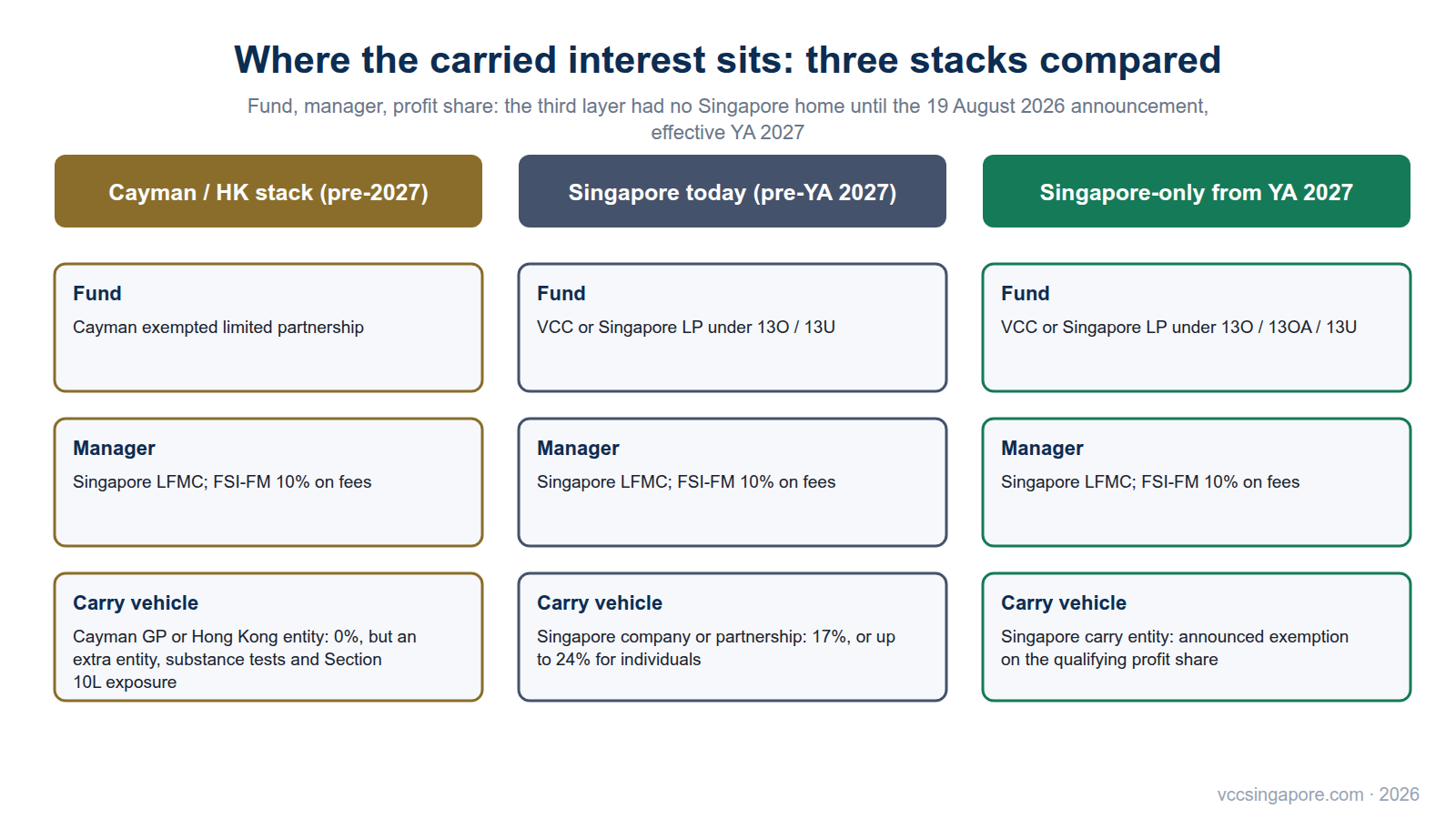
What the 19 August announcement changes
MAS and the Ministry of Finance will introduce a tax exemption on profit-related returns from the provision of fund management services to qualifying funds. The scope, as published, has four features that matter for structuring:
- It covers the profit share itself. Traditional carried interest and profit- or return-sharing models are in; ordinary salaries, bonuses and other remuneration are explicitly out.
- It follows the money through the structure. The exemption applies where a share of a qualifying fund’s profits is contractually received by corporate entities, partnerships or individuals, directly or indirectly, for providing fund management services — the words that let a Singapore carry partnership, its corporate partner and the individual professional all sit inside one regime.
- “Qualifying fund” is defined by the existing awards. Funds exempt under Sections 13D, 13O, 13OA, 13U or 13V, managed by Singapore-based fund managers. The fund-level award becomes the gateway to the manager-level exemption.
- It starts with YA 2027 — the 2026 income year — with mechanics at Budget 2027. Conditions are expected to include local business spending and Singapore-based investment-professional headcount, in the mould of the fund awards.
Two companion measures complete the picture: a new MAS Hedge Fund Investment Programme that will invest with managers committed to building in Singapore, and an Investment Management Track under the ONE Pass that counts performance-linked returns, not just fixed salary, toward the visa threshold — the profile whose payslip understates their economics.
Hong Kong’s carried-interest regime
Honesty about the benchmark is the point of this page. Hong Kong’s 2026 Bill, gazetted on 12 June, does not merely keep its 0% concession; it broadens it. HKMA certification is replaced by self-assessment through ordinary tax filing, the hurdle-rate requirement is dropped, eligible strategies extend from private equity to hedge funds, private credit, real estate and digital assets, and employees who hold a specified right to carried interest or performance fees — directly or indirectly — are covered at the salaries-tax level. The enhancements apply retrospectively from 1 April 2025. Proprietary trading houses stay outside, and the substance tests — Hong Kong personnel, local operating spend, investment decisions taken in Hong Kong — remain.
Read the analysis and conditions
A manager whose team genuinely sits in Hong Kong has a live, broad regime today. A manager whose team sits in Singapore has, from YA 2027, the one that fits the rest of its stack. The point of the Singapore package is not to out-bid Hong Kong on a single rate; it is that the fund exemption, the manager concession, the profit-share exemption, the vehicle and the visa are now all in the same jurisdiction, under the same regulator.
The cost of a multi-jurisdiction structure
Compare the recurring costs of offshore carry vehicles with the applicable tax treatment, implementation costs and obligations in each jurisdiction.
| Cost line | Cayman / Hong Kong stack | Singapore-only stack |
|---|---|---|
| Entities to run | Cayman fund + Cayman GP (+ Hong Kong carry entity) + Singapore manager: registered offices, economic-substance filings, separate directors and audits | VCC or Singapore LP + Singapore manager + Singapore carry vehicle, one auditor and one corporate secretary across the group |
| Foreign-asset gains received in Singapore | Since 1 January 2024, Section 10L taxes gains on foreign assets received in Singapore by an entity in a multi-jurisdiction group that lacks adequate economic substance here — a live risk for offshore carry vehicles whose owners sit in Singapore | Gains arise in entities with Singapore substance; incentivised entities are outside 10L |
| Tax on the profit share | 0% in Cayman; 0% in Hong Kong only with local substance and self-assessed eligibility; Singapore-resident recipients still manage characterisation on receipt | Announced exemption for qualifying-fund profit shares from YA 2027; details at Budget 2027 |
| Treaty access on portfolio flows | None from Cayman; investor-side relief only | Singapore’s comprehensive treaty network available to a resident fund with substance — see treaty access for VCCs |
| Divestment certainty on holdings | Depends on offshore entity’s position | Section 13W safe harbour: gains on ordinary shares held at 20% or more for 24 months are not taxable, and Budget 2025 removed the scheme’s sunset |
| Investor diligence | “Why is the carry offshore?” appears in every institutional questionnaire; three sets of KYC for banks and administrators | One jurisdiction to explain; onboarding under one MAS licence |
The components of a Singapore structure
| Layer | Singapore vehicle | Tax position | Gateway condition |
|---|---|---|---|
| Fund | VCC (umbrella with ring-fenced sub-funds) or Singapore LP under 13OA; an existing offshore fund can stay under 13U | 13O / 13OA / 13U exemption on qualifying income | Non-SFO 13O: S$5 million at entry, no annual re-test; 13U: S$50 million; local spending tiers from S$200,000. Always confirm the track that applies to you |
| Manager | A/I LFMC (S$250,000 base capital) or VCFM for venture funds — see setting up the management company | FSI-FM: 10% on qualifying fee income | Three investment professionals, S$250 million AUM, five-year award |
| Profit share | Singapore carry partnership or company holding the contractual entitlement under the fund documents | Announced exemption from YA 2027 | Profit share from a 13D/13O/13OA/13U/13V fund managed from Singapore; expected local spending and headcount conditions |
| Individuals | Partners or employees holding a direct or indirect profit share; ONE Pass Investment Management Track for senior hires | Inside the same exemption — salary and bonus remain taxable | Commercial, contractual profit-share terms; form consistent with substance |
| Co-investment and holding | Singapore holding entities alongside the fund | 13W safe harbour on qualifying divestments; 10L neutral where substance is real | 20% holding for 24 months; adequate economic substance in Singapore |
How to restructure: the sequence that works
1. Map the economics before touching any entity
List every vintage, its domicile, the general partner, the carry vehicle, the management and advisory agreements, and who ultimately receives what. Most stacks have accreted rather than been designed; the map usually shows two or three entities that exist only to hold a profit share.
2. Decide fund domicile vintage by vintage
Read the analysis and conditions
A live Cayman fund does not need to move for the manager to benefit: 13U takes an offshore vehicle of any legal form, so an existing fund under a Singapore 13U award is already a “qualifying fund”. The cleaner long-run answer is to launch the next vintage as a VCC sub-fund or a Singapore LP, and to consider inward re-domiciliation for older vehicles only when investor consent and cost line up — our Cayman-to-Singapore migration guide sets out that decision.
3. Bring the carry onshore for new vintages first
Read the analysis and conditions
For funds not yet closed, write the Singapore carry vehicle into the limited partnership agreement or the VCC sub-fund terms from day one: a Singapore partnership or company receives the contractual profit share, with the principals’ entitlements documented as commercial fund arrangements. For existing vintages, resist the urge to novate accrued carry. Moving an entitlement that has already built value can crystallise tax, needs limited-partner consent and rarely changes the outcome for a fund in its harvest phase. Let those vehicles run off.
4. Secure the gateway awards
The exemption is defined by reference to the fund awards, so the sequencing is: licensed manager first (the CMS licence or VCFM registration), then 13O/13OA/13U for each vehicle, then FSI-FM once the manager clears three professionals and S$250 million. A manager without a qualifying fund has nothing for the new exemption to attach to.
5. Separate pay from profit share, on paper and in practice
Salary and bonus are excluded from the exemption; the profit share is not. Compensation documents should show a genuine contractual entitlement to fund profits — not discretionary pay relabelled as carry. Expect Budget 2027 to draw anti-avoidance lines exactly here.
6. Run the 10L and 13W checks on every holding entity
Any group entity that receives foreign-asset gains in Singapore needs adequate economic substance or an incentive award to stay outside Section 10L; any entity holding 20% of a portfolio company for 24 months should be positioned to use the 13W safe harbour. Both favour real Singapore operations over paper.
7. Retire the offshore entities on a timetable
Keep Cayman economic-substance filings and Hong Kong obligations current until the last vintage they serve has distributed, then strike off. A dated wind-down plan reassures investors that the change is administrative, not a flight.
When to retain the existing structure
Three groups should wait or stay put. Managers with a real Hong Kong team already have a broad, self-assessed regime and may keep the Hong Kong leg for that team’s economics. Managers running funds outside the 13D/13O/13OA/13U/13V family have no qualifying fund and therefore no exemption to structure toward until they obtain an award. And anyone whose plan depends on a detail not yet published — the definition of outperformance, how sub-fund allocations inside a VCC umbrella are treated, the exact spending and headcount conditions — should build for optionality now and finalise after Budget 2027. Nothing announced changes the home-country tax of non-resident partners; a Singapore carry vehicle solves the Singapore layer, not theirs.
Singapore versus Hong Kong on the profit share
| Hong Kong (2026 Bill) | Singapore (19 August 2026 announcement) | |
|---|---|---|
| Rate | 0% at profits-tax and salaries-tax level | Exemption on qualifying profit-related returns |
| Effective | Retrospective to 1 April 2025 (YA 2025/26), subject to passage | YA 2027; mechanics at Budget 2027 |
| Funds covered | PE, hedge, private credit, real estate, digital assets | Funds with 13D / 13O / 13OA / 13U / 13V awards managed from Singapore |
| Approval | Self-assessment; HKMA certification removed | Expected to ride on the existing MAS award process |
| Hurdle rate | No longer required | “Outperformance” wording — definition pending |
| Who | Qualifying persons and employees with a specified right, directly or indirectly | Corporate entities, partnerships or individuals, directly or indirectly |
| Substance | Local personnel and operating spend; decisions made in Hong Kong | Expected local spending and Singapore-based professional headcount |
| Pairs with | Unified fund exemption; FIHV regime for family vehicles | 13O/13U fund exemptions, FSI-FM, VCC, ONE Pass Investment Management Track, Hedge Fund Investment Programme |
Read together with our Singapore-versus-Hong-Kong domicile comparison, the pattern is consistent: Hong Kong competes hardest on the headline rate, Singapore on the coherence of the whole stack. For a manager whose people, licence and vehicle are already here, coherence is the cheaper thing to own.
Restructuring your fund economics onshore?
Set out the fund vintages, carried-interest arrangements and team locations. We can outline the Singapore vehicle and service-provider options and introduce licensed managers or fund-services providers for a detailed review.
Discuss your requirements →Frequently asked questions
Does the Singapore exemption cover carried interest paid to a Cayman general partner?
As announced, the exemption applies to a share of a qualifying fund’s profits contractually received — directly or indirectly — by corporate entities, partnerships or individuals for providing fund management services, where the fund holds a 13D, 13O, 13OA, 13U or 13V award and is managed by a Singapore-based manager. A Cayman general partner with no Singapore nexus is not what the measure is built for; the practical route is a Singapore carry vehicle written into the fund terms, with the mechanics confirmed at Budget 2027.
When does the fund-manager profit-share exemption start?
From Year of Assessment 2027, which corresponds to the 2026 income year, with detailed conditions to be announced at Budget 2027. Managers should treat the scope as provisional until then and structure new vintages for optionality rather than restructuring accrued carry now.
Do I still need a Cayman fund to sit under a Singapore manager?
No. A VCC sub-fund or a Singapore limited partnership under Section 13OA can hold the same investor base, and an existing offshore fund can remain in place under Section 13U, which accepts a vehicle of any legal form. The decision is best made vintage by vintage: launch new funds onshore, and move older ones only when investor consent and cost justify it.
What should we do with an existing offshore carry vehicle?
Usually leave it to run off. Novating carried interest that has already accrued can crystallise tax, requires limited-partner consent and seldom improves the outcome for a fund in harvest mode. Put the Singapore carry entity into the documents of the next fund, keep Cayman economic-substance and Hong Kong filings current until the old vintages have distributed, then strike the entities off on a published timetable.
How does Singapore compare with Hong Kong’s 0% carried-interest concession?
Hong Kong’s 2026 Bill is broader and already live in effect: self-assessed, no hurdle rate, covering hedge, credit, real-estate and digital-asset funds, retrospective to April 2025, with local substance required. Singapore’s exemption arrives from YA 2027 and is defined through the 13O/13U family of fund awards, so it sits inside the same jurisdiction as the fund exemption, the FSI-FM manager concession, the VCC and the ONE Pass. Where the team is based generally decides which regime fits.
- MAS — Measures to strengthen Singapore’s competitiveness as a leading asset management hub (19 August 2026)
- Allen & Gledhill — scope of the proposed exemption (qualifying funds under ss 13D, 13O, 13OA, 13U, 13V)
- Baker McKenzie — Hong Kong Inland Revenue (Amendment) Bill 2026: funds, FIHVs and carried interest
- Income Tax (Concessionary Rate of Tax for Financial Sector Incentive Companies) Regulations 2017
- IRAS — e-Tax Guide: Tax treatment of gains or losses from the sale of foreign assets (Section 10L)