
Singapore’s proposed exemption for fund-manager profit-related returns
MAS and the Ministry of Finance announced an exemption for qualifying fund-manager profit-related returns on 19 August 2026, alongside changes to investment-professional visa access and a hedge-fund investment programme. This guide separates the announced scope from the conditions due at Budget 2027.
Structuring follow-up (2 September 2026): How to restructure a Cayman or Hong Kong carry stack to Singapore-only.
The short answer
Singapore has committed to exempting from tax a share of the profits that fund managers and investment professionals earn when they deliver strong returns for investors in qualifying funds. In industry terms, that is performance economics — the carried interest and performance-linked pay that drives the asset management business — and the signal is unambiguous: it is Singapore's answer to Hong Kong's 2026 bill offering tax concessions on fund managers' performance pay. The exemption is expected to reach broadly — hedge fund managers, professionals managing single-family-office funds, venture capital and other institutions — and will apply to qualifying personal income from the 2026 calendar year, with full details at Budget 2027 (typically February). Two further measures came with it: expanded access to the Overseas Networks & Expertise Pass for senior investment professionals, and a forthcoming investment programme to anchor hedge funds committed to building their Singapore presence. (For the news-format rundown of the announcement itself, see our report.)
The Hong Kong policy context
The trigger is competitive and MAS did not pretend otherwise, citing "growing international competition" in asset management. In May 2026 Hong Kong unveiled a bill to cut taxes on performance bonuses and carried interest for individual fund managers; in July the Alternative Investment Management Association wrote to MAS warning that the bill would widen the effective personal tax gap between the two hubs. The backdrop makes the stakes concrete: Hong Kong's assets under management grew 20% in 2025 to HK$42.2 trillion (≈US$5.4 trillion) on surging net inflows, against Singapore's 10% growth to S$6.7 trillion (≈US$5.2 trillion) — and Singapore's hedge fund sleeve, which had grown 37% in 2024 to S$327 billion as firms from the largest global multi-strategy platforms expanded locally, slowed to 5% growth in 2025.
Read the analysis and conditions
Hedge funds concentrate their economics in a handful of professionals; firms build teams and offices around individual performers, so personal tax on performance pay moves real headcount decisions. Announcing the direction now — six months before the Budget carries the detail — was deliberate: as MAS deputy chairman Chee Hong Tat put it, the industry should be able to take the plans into account "when deciding where to locate and grow their businesses." The industry accounts for roughly 15% of Singapore's financial-sector output and 13% of its employment; the quote that followed — "my colleagues and I will do what it takes" — is about as unhedged as Singapore policy language gets.
The three measures
| Measure | What it does | Status |
|---|---|---|
| Performance-profit tax exemption | Exempts a share of profits earned by fund managers and investment professionals for strong returns in qualifying funds — expected to span hedge funds, SFO managers, VC and more | Applies to income from calendar 2026; details at Budget 2027 |
| ONE Pass expansion | The S$30,000/month salary bar for the five-year, multi-employer Overseas Networks & Expertise Pass can now be met with other forms of income for senior asset-management executives | Announced with MOM; confirm current criteria before applying |
| Hedge fund anchoring programme | An investment programme to anchor hedge funds "committed to establishing or deepening their presence in Singapore" | Details to be shared later |
Relationship to existing fund and manager incentives
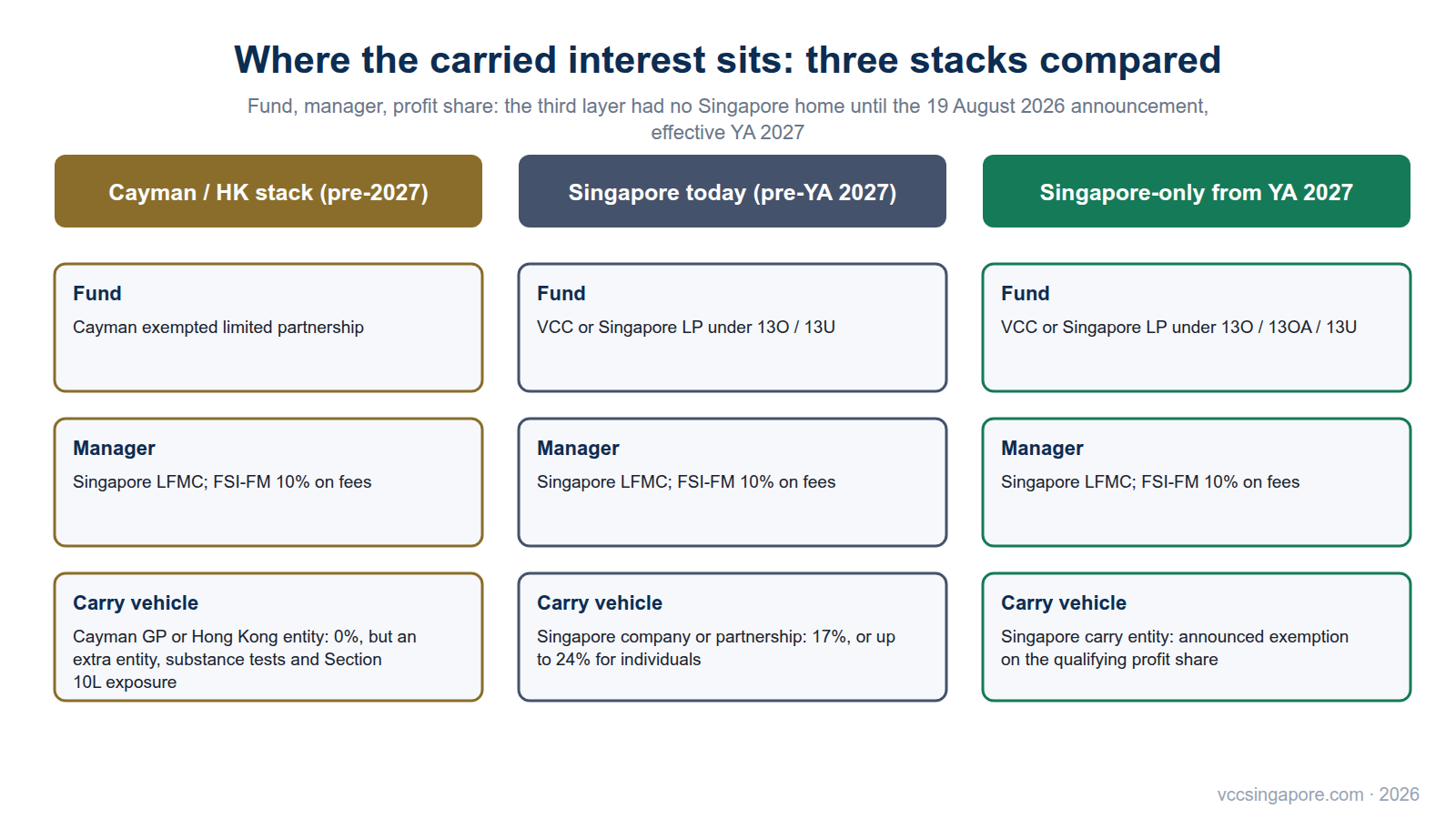
Singapore's fund tax architecture has always been strongest at the fund level: 13O, 13OA and 13U exempt qualifying income earned inside the vehicle, and the FSI scheme gives the management company concessionary rates on fee income. The layer it never directly addressed was the individual professional's performance economics — the share of upside that, in a hedge fund or VC firm, is the entire reason the business exists. Hong Kong found the gap; the August announcement closes it. If Budget 2027 delivers on the direction, the stack becomes complete in a way no regional rival currently matches end-to-end:
- The fund — specified income on designated investments exempt under 13O/13OA/13U, with the 2026 closed-end treatment easing the conditions for drawdown strategies;
- The management company — concessionary tax on management fees under the FSI scheme, inside a licensed fund management company;
- The professional — the newly announced exemption on the performance share, plus a five-year multi-employer visa to hold the person, not just the firm;
- The vehicle — the VCC carrying it all, with ring-fenced sub-funds per strategy or vintage.
What we know, and what waits for Budget 2027
Known: the exemption targets a share of profits tied to delivering strong returns in qualifying funds; it is intended to reach beyond hedge funds — family office, venture capital and other investment professionals were named in coverage; and it is set to apply to qualifying personal income generated from the 2026 calendar year, so performance earned now is intended to benefit.
Read the analysis and conditions
Unknown: the exempt share and any caps; what "strong returns" and "qualifying funds" mean in conditions; how the exemption interacts with employment income versus partnership or carry allocations; whether fund-level awards such as 13O/13U are prerequisites; and how anti-avoidance will be drawn. Hong Kong's bill is still moving through its legislature with its own scope fights, so the comparative arithmetic cannot be finalised on either side yet. Treat any adviser who claims to know the final Singapore mechanics today with scepticism — MAS itself has pointed everything to Budget 2027.
What managers should do now
- Document 2026 performance economics cleanly. The stated intent is that income from this calendar year qualifies. Keep the paper trail on performance allocations, carry crystallisations and bonus determinations unambiguous, so the position is ready whichever way the definitions cut.
- Revisit stalled Singapore plans. If the personal-tax gap was the reason a portfolio manager, pod or office decision went against Singapore in the last year, the calculus has formally changed — and the anchoring programme suggests negotiated support for committed hedge fund builds.
- Re-run the talent file. The ONE Pass change is aimed at exactly the profile whose base salary understates their economics. A five-year pass with multi-employer flexibility is a materially better instrument for senior investment hires than a standard employment pass.
- Structure ready, not reactive. The fund-level stack — VCC, 13O/13U, the closed-end treatment — is live today. Managers who set up now are positioned to layer the personal exemption on top when the mechanics land, rather than starting the whole build in 2027.
Weighing Singapore for your fund or team?
Tell us your strategy, where your investment team sits today, and what a Singapore build would need to look like. We'll walk you through the current fund-level exemptions, the structure options, and what the August 2026 announcements change — and connect you with MAS-licensed CMS fund managers where it's the right fit.
Discuss your requirements →What did MAS announce for fund managers on 19 August 2026?
Three things: a proposed tax exemption on a share of the profits that fund managers and investment professionals earn when they deliver strong returns for investors in qualifying funds — expected to cover hedge funds, single-family-office managers, venture capital and other institutions; expanded access to the Overseas Networks & Expertise Pass for senior asset-management professionals, with the S$30,000-a-month salary bar now satisfiable with other forms of income; and a new investment programme to anchor hedge funds committed to building their presence in Singapore.
When does the fund manager tax exemption take effect?
MAS has said the exemption will apply to qualifying personal income generated from the 2026 calendar year, with full details — scope, conditions and mechanics — to be released at Singapore's Budget in early 2027. Until then the announcement is a committed direction rather than enacted law, so treat specifics as provisional and confirm with MAS and IRAS as details land.
Is this the same as Hong Kong's carried-interest tax break?
It is Singapore's answer to it. Hong Kong's 2026 bill proposes tax concessions on performance-linked pay for individual fund managers, and industry bodies warned MAS in July that it would widen the effective personal tax gap between the hubs. Singapore's proposal targets the same economics — the performance share managers earn on strong returns — but the two regimes' final scope and conditions will differ; both are still being detailed.
How does this interact with the 13O and 13U fund exemptions?
They cover different layers. Sections 13O and 13U exempt qualifying income earned by the fund itself; the August 2026 proposal addresses the manager's own economics — the share of profits the management team earns for performance. Together with the existing concessionary rates on management fee income under the FSI scheme, Singapore would cover the fund, the management company and the individual professional.
What changed on the ONE Pass for investment professionals?
The Overseas Networks & Expertise Pass — a five-year visa that lets holders work for multiple employers without reapplying when they change roles — previously required a fixed monthly salary of S$30,000. For senior asset-management executives, other forms of income can now count toward that bar, which matters in an industry where performance pay dwarfs base salary. Confirm current criteria with MOM before applying.